Place · Pacific coast
Nuquí and Utría National Park
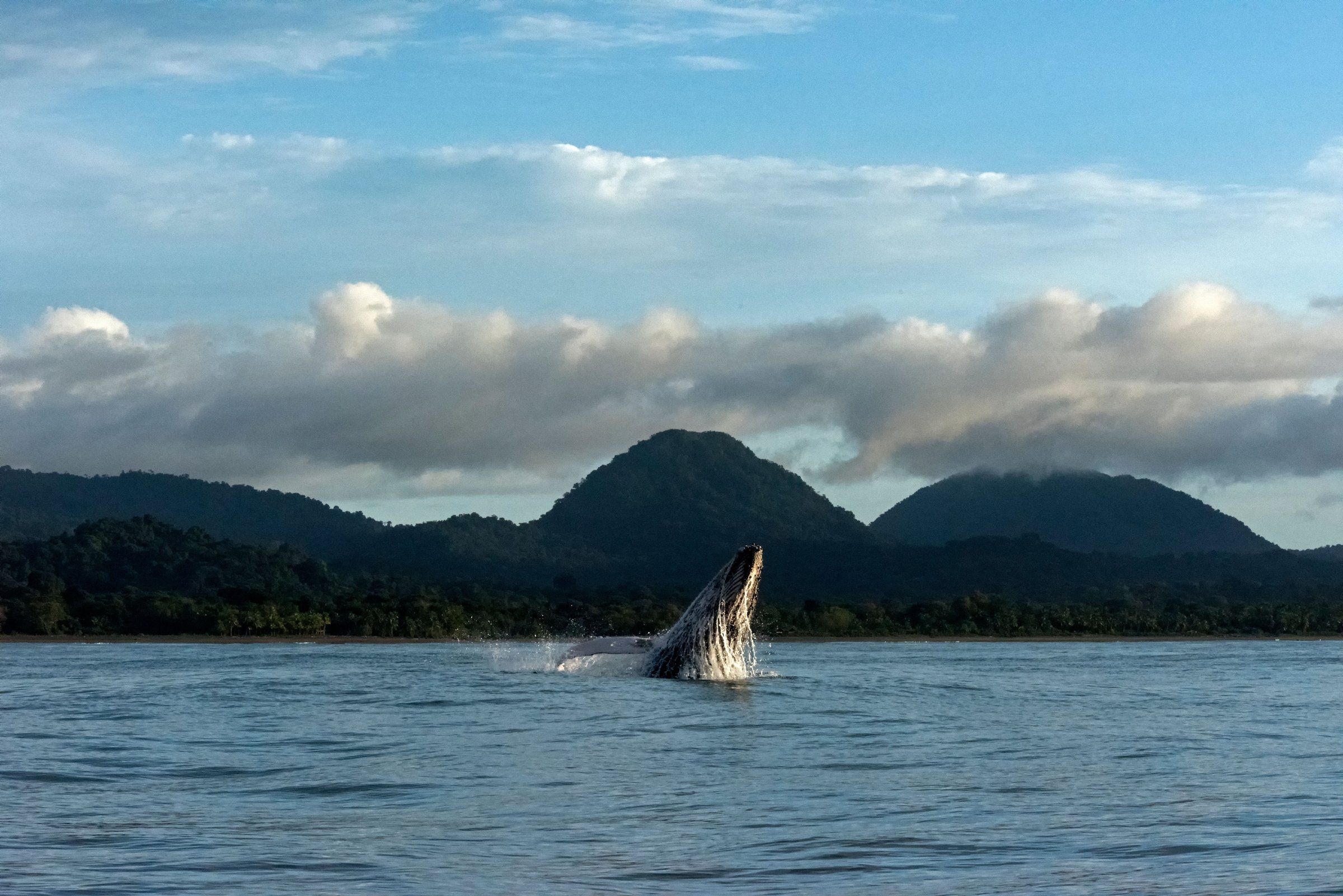
Nuquí, Colombia: humpback whales breaching near shore and jungle meeting the Pacific. Flights from Medellín, boat-access lodges, Utría park and prices.
In this guide
- How the Nuquí area is laid out
- Is Nuquí safe? Travel advice and the situation in 2026
- How to get to Nuquí
- Things to do in Nuquí
- Afro-Colombian and Emberá communities: visiting respectfully
- Nuquí lodge packages: what’s included and what they cost
- Where to stay in Nuquí: the areas
- Bahía Solano and El Valle: the alternative to the north
- How many days in Nuquí: sample itinerary
- Best time to visit Nuquí: weather and seasons
- Practical tips: cash, power, internet and health
- How much does a trip to Nuquí cost?
- Mistakes to avoid
- Frequently asked questions
Nuquí is where Colombia’s rainforest runs right down to the Pacific and, from July to October, humpback whales breach a few hundred metres off the beach. It’s an Afro-Colombian fishing village on the Gulf of Tribugá in Chocó, with no road connection: you fly in on a small plane from Medellín and carry on by boat to a lodge tucked between jungle and sea. I’d allow 4-5 days, and the easiest way to arrange them is a package with meals, transfers and excursions. Below you’ll find the safety situation, how to get there, things to do in Nuquí with prices, where to stay and a sample itinerary.
How the Nuquí area is laid out
The village of Nuquí (around 16,000 people in the whole municipality) is where you land: there’s the airstrip, the jetty, a few shops and some simple guesthouses. Almost all the lodges, though, are outside the village, spread along the coast and reachable only by boat, each one a little world of its own.
- South of the village: the communities of Coquí, with its mangroves, and Joví, at the mouth of the river of the same name; then the long beach of Guachalito, the village of Termales with its hot springs, and further on Arusí and Cabo Corrientes. This is where most lodges are.
- North of the village: the Gulf of Tribugá, with the villages of Tribugá, Panguí and Jurubirá (which also has hot springs), then the inlet of Utría, the national park, halfway to Bahía Solano.
- Further north: Bahía Solano and El Valle, a separate municipality with its own airport, covered further down.
According to local operators, boat rides from the village range from 15-20 minutes to Coquí to about 40-45 minutes to Guachalito and Termales, and an hour or more to Utría, depending on the sea. The rest of the coast, from Bahía Solano to Gorgona, is covered on our Pacific coast page.
Is Nuquí safe? Travel advice and the situation in 2026
Nuquí is one of the few parts of Chocó that foreign governments don’t specifically warn against, but the wider department remains troubled and the advice needs reading carefully:
- UK (FCDO), updated 30 October 2026: advises against all but essential travel to Chocó except Quibdó, Nuquí, Bahía Solano and Capurganá.
- US State Department: Colombia as a whole has been at Level 3, “reconsider travel”, since 31 March 2026. The Level 4 “do not travel” areas are Arauca, Cauca (except Popayán), Valle del Cauca (except Cali), Norte de Santander and the Venezuelan border; Chocó is not among them.
- Colombia’s Defensoría del Pueblo (ombudsman’s office): an early warning has been in force since 2024 (Alerta Temprana 009) for northern Pacific Chocó, including Nuquí, Bahía Solano and Juradó, because of armed groups.
Recent events worth knowing about:
- 1 November 2026: according to the Defensoría, around 500 Indigenous people from the community of Villa Nueva, in the Jurubirá district north of the village, were forced from their homes by fighting between the Clan del Golfo and the ELN, after two people were killed; the families took shelter in Jurubirá, and the nearby community of Puerto Indio was considering leaving too. Reports don’t mention tourists, but ask your lodge about the situation before booking a trip towards Jurubirá.
- In 2026 the ELN called several paros armados (armed strikes) in Chocó, for example for a week in March, mostly along the San Juan, Atrato and Baudó rivers, south and east of Nuquí.
- The 10 August 2026 earthquake, centred near San José del Palmar in southern Chocó, mainly hit Cali and the Coffee Region. Reports on Nuquí conflict: the municipal ombudsman spoke of widespread damage, while Corporación Mano Cambiada, Nuquí’s community tourism organisation, reported no significant damage. Lodges kept working through whale season, and the new terminal at Bahía Solano was undamaged.
In practice: visit Nuquí through a lodge or a registered agency, not independently with a backpack and tent; stay within the village, your lodge and organised trips; follow your hosts’ advice. The bigger picture is in our guide to safety in Colombia.
How to get to Nuquí
You can only get to Nuquí by air (or on slow cargo boats): no road links it to the rest of the country. Reyes Murillo airport (NQU) is a short airstrip a few minutes’ walk from the village.
- From Medellín: flights leave from Olaya Herrera, the in-town airport, not José María Córdova in Rionegro where international flights land (allow 45-60 minutes by taxi between them). Satena and Clic fly the route in about 50 minutes; Skyscanner listed around 17 flights a week in May 2026. Satena shows fares from about 169,900 pesos one way; between July and October seats sell out early and prices rise.
- From Quibdó: short Satena flights. Only useful if you’re already in Chocó’s capital.
- From Bogotá, Cali and Pereira: you usually connect in Medellín. Clic has run seasonal flights from Pereira, but I couldn’t find confirmed direct routes for 2026.
- By boat from Buenaventura: some cargo boats take passengers, with journeys of more than a day, but Buenaventura is covered by both UK and US travel warnings. I wouldn’t do it.
Baggage: these are small planes and limits are tight. Satena’s 2026 conditions cap hand luggage at 5 kg (11 lb); the checked allowance depends on the fare, and many agencies quote 10-15 kg (22-33 lb). Bring a soft bag rather than a hard suitcase and check your fare before you fly.
From the airstrip to your lodge: someone from the lodge usually meets you and walks you to the jetty, where you board a launch. The transfer is often included in packages; if not, it’s expensive (one Guachalito lodge charges 290,000 pesos per person return). At low tide you land straight on the beach in knee-deep water: carry your shoes and keep your phone in a dry bag.
Return flights depend on the weather and are sometimes moved earlier or later: don’t book an international flight on the same day, and spend at least one night in Medellín.
Tourist tax and entry requirements
- Nuquí tourist tax: paid on arrival and usually not included in packages. Sources disagree on the amount: agencies quote 30,000-50,000 pesos per person, and one lists 35,000 pesos for Colombians and 45,000 for foreigners, with children under 10 exempt. I couldn’t find the municipality’s official resolution, so have 50,000 pesos in cash ready. Some agencies also mention an airport fee of about 10,000 pesos on departure.
- Yellow fever: Colombia’s Ministry of Health table, updated on 31 March 2026, rates Nuquí and Bahía Solano as high risk, and Colombian rules call for vaccination for anyone travelling to high-risk municipalities. I found no recent rule on showing the certificate: a 2017 circular allowed airlines to ask for it at check-in, but there are no reports of systematic checks. Get vaccinated at least 10 days before travelling and carry your international certificate. Everything else is in our guide to Colombia’s entry requirements.
Things to do in Nuquí
| What | Time | Indicative price |
|---|---|---|
| Whale watching (July-October) | 2-3 hours | often included; about 180,000 pesos as an extra |
| Utría National Park | full day | 80,000 pesos entrance for foreigners, plus the boat |
| Termales hot springs | 1-2 hours | 12,000-20,000 pesos |
| Cascada del Amor and Guachalito | half day | usually with your lodge’s guide |
| Joví River by canoe | half day | often included |
| Coquí mangroves | 2-3 hours | often included |
| Surfing, fishing, birdwatching | varies | arranged with your lodge |
Whale watching in Nuquí
Humpback whales travel up from the cold waters of Antarctica and Chile to give birth and mate in the Gulf of Tribugá. The season runs from July to October, with August and September the best months; exact dates shift every year, and some sources report the first whales in mid-June and the last in early November. You’ll often spot them from the beach or your lodge, but a boat trip is something else: mothers with calves, breaches, tail slaps and, with a hydrophone, the males’ song.
Rules from Dimar, Colombia’s maritime authority, apply to every operator: at least 200 metres (about 650 ft) from the whales, low speed, engine in neutral when a group approaches, never chase or surround them. One source also mentions a 30-minute limit per group and trips between 8am and 4pm. If your boat ignores these rules, say so: it’s a good reason to pick another operator.
Trips last 2-3 hours and almost every whale-season package includes one; as an add-on one agency sells it for about 180,000 pesos per person. Sightings aren’t guaranteed, and rough seas mean postponing.
Utría National Park
Utría National Natural Park protects a narrow, deep inlet with mangroves, a small coral reef and rainforest climbing the Baudó hills. It’s one of the places where humpbacks come closest to shore. Inside the park you walk short trails, including the Estero Grande mangrove boardwalk and the Cocalito trail, always with a guide, which is compulsory.
- 2026 entrance fees (Resolución 551 of 2025): 80,000 pesos for non-resident foreigners, 28,000 for Colombians, residents and Andean Community nationals over 25, 19,000 for under-25s. The park collects fees in cash.
- How to visit: as a day trip by boat from Nuquí (an hour or more) or from El Valle (much closer). According to Parques Nacionales, in August 2026 visitors entered in the morning and left at the times set by the park; there has been no lodging or restaurant inside the park for years. The park authority has also stated that Corporación Mano Cambiada hasn’t run services inside Utría since 2019, so be wary of anyone selling nights “in the park”.
- Closures: the park can close for security reasons or tsunami alerts, as it did for a day in July 2025. Ask your lodge the evening before.
Hot springs: Termales and Jurubirá
In Termales, south of the village, a hot spring runs down through rocks into small pools in the forest, managed by the community: entry costs 12,000-20,000 pesos according to agencies. Late afternoon or after a rainy day is best, when the hot water and cool air make a nice contrast.
The Jurubirá hot springs, to the north, are reached by boat and a walk through the forest. They’re wilder and quieter, but they lie right in the area of the November 2026 displacements: go only if your lodge confirms things are calm.
Guachalito beach and waterfalls
Guachalito is Nuquí’s finest beach: a few kilometres of grey sand backed by palms and rainforest, between Joví and Termales. Trails lead from here to waterfalls in the forest, the best known being the Cascada del Amor, with a pool for swimming: you reach it on foot along an often muddy forest trail, ideally with a local guide and shoes you don’t mind getting wet. Since June 2026 Guachalito has had round-the-clock power from a community solar plant.
Joví and Coquí: river and mangroves by canoe
At Joví you paddle up the river in a dugout canoe (potrillo) to freshwater pools and a waterfall, often with a guide from the community. At Coquí, a few minutes from the village, you explore a maze of mangroves, best at high tide, while guides explain fishing and the gathering of piangua, the mangrove cockle. Both are gentle outings, ideal for days when the sea is rough.
Surfing, sport fishing and birdwatching
- Surfing: the best waves are south of the village, around Pico de Loro, Juan Tornillo, the El Cantil area and Punta Arusí, all reached by boat. These are beach and reef breaks for surfers with some experience; some lodges rent boards and run surf trips.
- Sport fishing: tuna, dorado (mahi-mahi) and snapper, mostly catch-and-release, arranged through lodges or local fishermen.
- Birdwatching: the Chocó bioregion has one of the highest numbers of endemic species on earth. In the forest around Utría and Joví, with a guide, you’ll see toucans, hummingbirds and seabirds such as boobies.
- Sea turtles: a few Nuquí lodges support conservation projects, but the best-known place for hatchling releases is El Valle, to the north (see below).
Pacific coast food
Food in Nuquí revolves around fish, coconut and green plantain. Try pescado encocado (fish in coconut sauce), rice with piangua, tapao (fish stewed with plantain), patacones and borojó juice, from a strong-tasting local fruit. Viche is the Pacific coast’s sugarcane spirit, distilled at home by Afro-Colombian families and recognised in law in 2021 as an ancestral drink: worth a taste, in moderation. Lodges serve whatever the fishermen bring in that day.
Afro-Colombian and Emberá communities: visiting respectfully
The Nuquí coast is home mainly to Afro-Colombian communities, organised in consejos comunitarios (in Nuquí, the Consejo Comunitario Los Riscales) that hold collective title to the land, and to Emberá Indigenous communities in their resguardos (reserves). Tourism here began as community tourism, with local groups such as Corporación Mano Cambiada, and many guides, boatmen and lodge cooks come from the villages.
To do your bit:
- Choose local guides and boats, and ask your lodge who runs its trips.
- Some villages and trails ask for a small community fee: pay it without haggling.
- Ask before photographing people and homes, especially in Emberá communities, where visits only happen if organised and agreed by the community.
- Buy crafts and food directly from the people who make them.
Nuquí lodge packages: what’s included and what they cost
Almost everyone visits Nuquí on a package: a few days with transfers, meals and excursions bundled together, because services are few and improvising doesn’t work. Packages usually include the boat transfer from the airstrip and back, full board, a few excursions (hot springs, waterfalls, canoeing) and, in season, a whale-watching trip. They often don’t include flights, the tourist tax, the Utría fee, drinks or tips.
| Package type | Length | Indicative price |
|---|---|---|
| With flights from Medellín, shared room | 4 days, 3 nights | from about 2,450,000-2,700,000 pesos per person |
| No flights, with meals and excursions | 4 days, 3 nights | about 1,590,000-2,660,000 pesos per person |
| High-end lodges | per night | mostly sold in US dollars |
Prices come from agencies’ 2026 whale-season rates and vary a lot with room type (double or quad) and lodge. Choosing an operator: Colombian agencies and accommodation must be listed on the Registro Nacional de Turismo (RNT, the national tourism register). Ask for the number, check it on the RNT website and get what’s included in writing.
Where to stay in Nuquí: the areas
- Nuquí village: guesthouses and small budget hotels, handy for your first or last night and for using the village boats. Downsides: a less attractive beach, fewer whales from shore and little going on in the evening.
- Termales and Guachalito: the area with the most lodges, from simple family-run ecolodges to high-end properties. Pros: the best beach, with hot springs and waterfalls on foot. Cons: 40-45 minutes by boat from the village, so transfers cost more.
- Joví and Coquí: small, quiet lodges 15-30 minutes from the village, close to the river and mangroves. A good choice for canoeing and forest with short transfers.
- Arusí, Pico de Loro and El Cantil: the most remote lodges, towards Cabo Corrientes, popular with surfers. Pros: waves and near-untouched nature. Cons: far from everything, every outing needs a boat.
- North, towards Utría: a few lodges in secluded coves, convenient for the park and for whales close to shore. Before booking, ask about the situation around Jurubirá.
On booking sites prices are mostly shown in dollars or euros: village guesthouses are the cheapest option, while full-board lodges cost several times as much. Many lodges can only be booked direct or through agencies.
Bahía Solano and El Valle: the alternative to the north
Bahía Solano is a separate municipality about 2 hours north of Nuquí by boat, with its own airport (José Celestino Mutis, BSC), served mainly from Medellín Olaya Herrera and Quibdó by Satena, Clic and Moon Flights; its new passenger terminal opened on 25 September 2026. Linked to Bahía Solano by a road of about 18 km (11 miles) is El Valle, with the long beach of Playa Almejal, surf, waterfalls and the closest access to Utría.
How it differs from Nuquí:
- More simple places to stay and lower prices; it’s easier to get around independently, on foot or by motorbike taxi.
- Sea turtles: in El Valle three local associations protect nests on Playa Cuevita and release hatchlings a few days old, mostly in the second half of the year (sources don’t give precise dates).
- Utría is closer: from El Valle it’s a short boat ride or a guided hike.
- ATMs: Bahía Solano has just one, often out of order, according to Colombia’s tourism board.
Bahía Solano and El Valle deserve their own guide, which I’ll write. For now, if you’re staying there, whale-watching trips and waterfall hikes are in the box below.
How many days in Nuquí: sample itinerary
You need 4-5 days in Nuquí, plus a night in Medellín before and after. With 3 days you’ll fit in the whales and one or two trips but lose a lot of time to flights and boats; with 6-7 days you can add Utría and a second lodge in a different area.
- Day 1: morning flight from Medellín Olaya Herrera, tourist tax on arrival, boat to your lodge. Afternoon on the beach and, in Termales, a soak in the hot springs at sunset.
- Day 2: whale watching in the morning, when the sea is calmest; afternoon walk to the Cascada del Amor.
- Day 3: day trip to Utría National Park, with the mangrove trail and whales on the way.
- Day 4: canoeing on the Joví River or the Coquí mangroves in the morning, free afternoon or surfing.
- Day 5: boat back to the village and flight to Medellín. If your flight is in the afternoon, take a walk around the village and jetty.
Combining Nuquí with Medellín: arrive in Medellín at least the day before your flight, stay in an area close to Olaya Herrera (El Poblado and Laureles are 15-25 minutes away by taxi) and keep a spare day after you come back, in case bad weather delays your flight.
Best time to visit Nuquí: weather and seasons
Nuquí lies in one of the wettest places on earth: about 6,700 mm (265 in) of rain a year according to Climate-data, spread across every month. It’s hot and humid all year, averaging around 25°C (77°F) with highs of about 30°C (86°F). Rain often falls at night or in short, heavy bursts, with sunny spells in between.
- July-October: whale season, the most popular time. Lodges book up months ahead and flights fill; August and September are the best months for sightings.
- January-March: according to climate averages, the slightly less rainy period, often with calmer seas; no whales, but rainforest, hot springs, surf and empty beaches.
- Colombian holidays (December-January, Easter week, June-July): more domestic tourists and higher prices.
How the Pacific compares with other regions is covered in our guide on when to visit Colombia.
Practical tips: cash, power, internet and health
- Cash: don’t count on an ATM in Nuquí, and bring from Medellín all the pesos you’ll need for the tax, tips, extras and drinks. Many lodges accept cards or transfers only for the booking itself. Cards and fees are covered in our guide to money in Colombia.
- Power: at many lodges it comes from solar panels or generators and is available only a few hours a day; Guachalito has had a community solar plant since June 2026, and one is on its way in Coquí. Bring a power bank.
- Internet: phone signal is weak or non-existent outside the village; some lodges have slow satellite wifi. Download maps and documents before you go.
- Health: Chocó is one of the Colombian departments with the most malaria cases, and dengue and yellow fever are present too. Ask your doctor or a travel clinic whether you need antimalarials, use a strong repellent and sleep under a net. Nuquí only has a basic health post: anything serious means flying to Medellín, so travel insurance with medical evacuation is essential.
- Water: drink bottled or filtered water, which lodges usually provide.
- What to pack: a poncho or rain jacket, quick-dry synthetic clothes, water shoes or closed sandals, light hiking shoes for the mud, a hat and sunscreen (even when it’s cloudy), a head torch and dry bags.
How much does a trip to Nuquí cost?
| Item | Indicative price |
|---|---|
| Medellín-Nuquí flight | from about 169,900 pesos one way (Satena), more in season |
| Nuquí tourist tax | 30,000-50,000 pesos depending on the source |
| Boat transfer to your lodge | often included; up to 290,000 pesos return |
| 3-night package with flights from Medellín | from about 2,450,000 pesos per person |
| Whale-watching trip | often included; about 180,000 pesos as an extra |
| Utría National Park entrance | 80,000 pesos for foreigners, 28,000 for Colombians |
| Termales hot springs | 12,000-20,000 pesos |
Mistakes to avoid
- Booking flights before your lodge: the lodge sets boat times and transfers.
- Travelling with a hard suitcase or over the weight limit: on small planes you’ll pay dearly or leave it behind.
- Arriving without cash: the tax is paid in pesos and there’s no ATM in the village you can rely on.
- Booking an international flight on the day you return from Nuquí.
- Underestimating the rain: without quick-dry clothes and dry bags, everything will be wet within three days.
- Choosing a boat that chases whales: it’s against the rules and disturbs the animals.
- Heading off alone to isolated spots or accepting boat rides from strangers, especially north of the village.
- Forgetting your yellow fever jab and repellent.
Frequently asked questions
How do you get to Nuquí, Colombia?
Only by air: Satena and Clic fly from Medellín’s Olaya Herrera airport in about 50 minutes, and Satena also flies from Quibdó. There are no roads; from the airstrip you continue by boat to your lodge.
When is whale season in Nuquí?
From July to October, with August and September the best months. Boat trips last 2-3 hours and boats must stay at least 200 metres from the whales.
Is Nuquí safe for tourists?
The UK advises against all but essential travel to most of Chocó but makes an exception for Nuquí, and the US State Department rates Colombia Level 3 without singling out Chocó for Level 4. Visiting with a lodge or registered agency and staying in tourist areas is possible; in November 2026 fighting between armed groups displaced people near Jurubirá, so check the latest before you go.
How much does a trip to Nuquí cost?
A 3-night package with flights from Medellín, meals and excursions starts at about 2,450,000 pesos per person in a shared room, according to agencies’ 2026 rates. On top of that you pay the tourist tax (30,000-50,000 pesos) and the Utría entrance fee (80,000 pesos for foreigners).
Nuquí or Bahía Solano?
Nuquí is better for a secluded lodge between rainforest and beach, with hot springs and waterfalls nearby; Bahía Solano and El Valle have simpler places to stay, lower prices, sea turtles and easier access to Utría. Both are excellent for whales.
Some links are affiliate links: if you buy through them I earn a small commission, at no extra cost to you. How it works
You might also like
Amazon
Leticia and Puerto Nariño
Leticia, Colombia's fly-in Amazon town where Brazil and Peru meet: pink river dolphins at Puerto Nariño, jungle lodges, entry taxes, prices and safety.
Caribbean coast
La Guajira: Cabo de la Vela and Punta Gallinas
La Guajira, Colombia's Wayuu desert that runs into the Caribbean: Cabo de la Vela and Punta Gallinas tours from Riohacha, prices, where to stay and safety.
Caribbean coast
Palomino
Palomino, Colombia: float a jungle river from the Sierra Nevada down to the Caribbean. Tubing prices, buses from Santa Marta, safe swimming and where to stay.