Place · Caribbean coast
La Guajira: Cabo de la Vela and Punta Gallinas
La Guajira, Colombia's Wayuu desert that runs into the Caribbean: Cabo de la Vela and Punta Gallinas tours from Riohacha, prices, where to stay and safety.
In this guide
- How La Guajira is laid out: Riohacha, Uribia and the Alta Guajira
- Tour or independent? How to visit Cabo de la Vela and Punta Gallinas
- Things to do in Cabo de la Vela
- Punta Gallinas: Taroa dunes, Bahía Hondita and the lighthouse
- Riohacha and around: what to do before and after the tour
- Is La Guajira safe? UK and US travel advice and 2026 news
- Wayuu communities: guesthouses, etiquette and children on the tracks
- How to get to Riohacha
- Where to stay: Riohacha, Cabo de la Vela and Punta Gallinas
- How many days you need and an itinerary
- Best time to visit La Guajira
- Practical tips: cash, water, power, sun and wind
- How much La Guajira costs
- Mistakes to avoid
- FAQ
La Guajira is the peninsula at the very top of Colombia: red sand, cactus and constant wind, with the desert running straight into the Caribbean. It’s the homeland of the Wayuu, Colombia’s largest Indigenous people, and travellers come for two places: Cabo de la Vela, a fishing village on a flat, windy bay that kitesurfers love, and Punta Gallinas, the northernmost point of South America, where sand dunes drop into the sea. You get there on a 4x4 tour from Riohacha, and I’d allow four days: one night in the city and a three-day tour. Below you’ll find how to plan it, what it costs, where you sleep and what UK and US travel advice says, which matters more here than in most of Colombia.
How La Guajira is laid out: Riohacha, Uribia and the Alta Guajira
It helps to think of La Guajira in three bands. In the south is the green strip at the foot of the Sierra Nevada, home to Palomino. In the middle is Riohacha, the capital, on the coast, with the airport, ATMs and buses: almost every tour starts here. North of Uribia begins the Alta Guajira (Upper Guajira): desert, unsigned sand tracks, scattered settlements and hardly any services.
Most of the Alta Guajira is Indigenous land (the Wayuu reserve of the Alta and Media Guajira). Families live in rancherías, small clusters of houses belonging to one extended family, and they run the guesthouses, the places to eat and often the guiding too. Riohacha to Cabo de la Vela takes around 3-4 hours; Cabo de la Vela to Punta Gallinas is another 3-4 hours of track, depending on stops and conditions.
Tour or independent? How to visit Cabo de la Vela and Punta Gallinas
For most travellers the answer is an organised tour. The desert tracks have no signs, change after every storm and cross land belonging to different communities, and in 2026 there were robberies on the roads out of Riohacha (more on that below). Tours leave from Riohacha, and many also from Santa Marta and Palomino with the transfer included.
| Tour | What you see | Typical price per person |
|---|---|---|
| Day trip from Riohacha | a rushed Cabo de la Vela, with about 3 hours’ driving each way | about 300,000 pesos |
| 2 days, 1 night | Uribia, sometimes the Manaure salt flats, Cabo de la Vela at sunset | 350,000-550,000 pesos from Riohacha; up to about 900,000 from Santa Marta |
| 3 days, 2 nights | Cabo de la Vela plus Punta Gallinas, the Taroa dunes and Bahía Hondita | 800,000-1,200,000 pesos from Riohacha; about 1,300,000 from Santa Marta |
| 4-5 days | all of the above plus Macuira National Park and Nazareth | ask operators |
These figures come from Colombian operators’ 2026 price lists; you’ll find the same tours sold online in US dollars, often for more. A package usually covers the 4x4 and driver, nights in a hammock or chinchorro, most meals and the small payments to communities along the way; drinks, tips and optional boat trips are extra. Before you pay, ask:
- how many people share the jeep (4-5 is comfortable, 7-8 isn’t);
- where you’ll sleep: hammock, chinchorro or room, and whether the places are Wayuu-run;
- whether the operator is on Colombia’s National Tourism Register (RNT) and how it keeps in touch with local authorities along the route;
- what time you get back to Riohacha on the last day, if you have a flight or bus to catch.
I’d skip the day trip: you spend six hours in a car to see Cabo de la Vela in the midday heat and leave before sunset.
Getting to Cabo de la Vela without a tour
You can reach Cabo de la Vela on local transport, but it’s slow and the fares quoted by sources vary a lot:
- Riohacha → Uribia: colectivo, shared taxi or bus, 1-1.5 hours, between 15,000 and 30,000 pesos depending on the source and vehicle.
- Uribia → Cabo de la Vela: shared 4x4 pickup or truck that leaves when full, 1.5-3 hours. A Colombian guide from 2024 gives 40,000-70,000 pesos per person; older English-language blogs say 15,000-20,000.
Get to Uribia by late morning, as rides to the Cabo dry up after lunch, and buy water and snacks there, because everything costs more at the Cape. There’s no public transport to Punta Gallinas: from the Cape or Uribia you need a 4x4 with a driver, which the Punta Gallinas guesthouses or agencies in Cabo de la Vela can arrange. Don’t drive yourself beyond Uribia, even in a rented 4x4: without a local driver it’s very easy to get lost.
Things to do in Cabo de la Vela
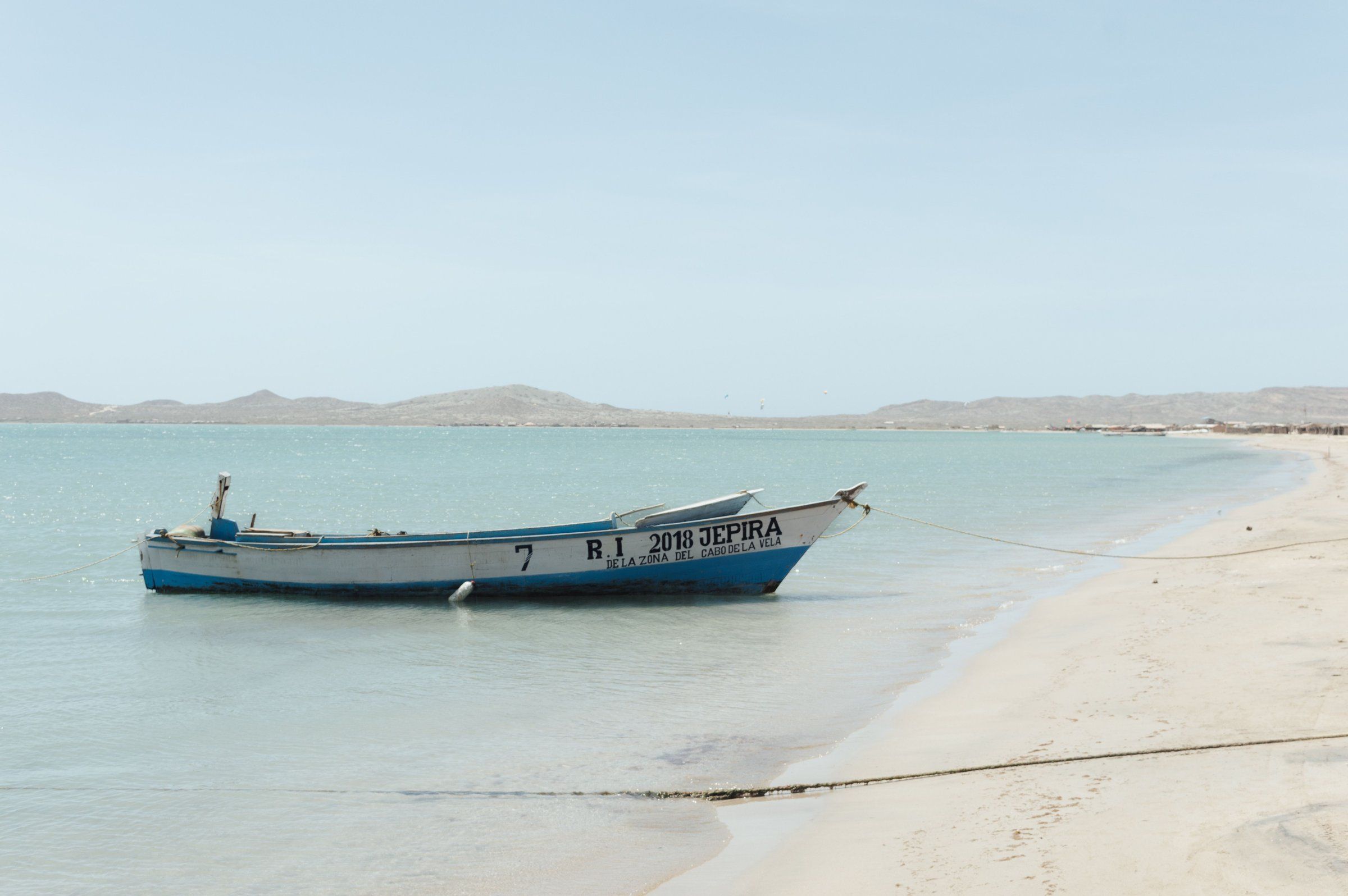
Cabo de la Vela, called Jepira in Wayuunaiki, is a village strung along one sandy street, facing a shallow, calm bay. It’s a sacred place for the Wayuu: according to tradition, this is where the souls of the dead set off for the afterlife. The sights are a few kilometres outside the village, so you reach them in your tour’s 4x4 or with a ride arranged by your guesthouse.
| Sight | Time | Notes |
|---|---|---|
| Pilón de Azúcar | 1-2 hours | a hill above the sea topped by a statue of the Virgin, with a golden beach below |
| Ojo de Agua | 1 hour | a beach between cliffs, with a tiny freshwater spring |
| Lighthouse | 1 hour | the classic sunset spot |
| Kitesurfing in the bay | from an hour to several days | lessons and rental at the village schools |
- Pilón de Azúcar (Kamaichi): a short climb on a stony path gives you the view of the desert ending in the sea. It’s the place most closely tied to Jepira, so treat it like a place of worship. Below is Playa del Pilón, with orange sand and the strongest waves in the area: only swim where you can stand.
- Ojo de Agua: a more sheltered cove between red rocks. The “spring” it’s named after is tiny, so come for the scenery rather than a natural pool.
- The lighthouse: every tour turns up here for sunset, so expect company. A new lighthouse was switched on near the Pilón in 2024.
- Kitesurfing: the bay has flat water and steady wind most of the year, strongest in the afternoon and least reliable in October and November; December to April is the peak season. Schools often quote lessons in US dollars, so ask for the price in pesos. One guide suggests complete beginners start at Mayapo, near Riohacha, where learning is easier.
Punta Gallinas: Taroa dunes, Bahía Hondita and the lighthouse
Punta Gallinas is the northernmost point of mainland South America: a headland of rock and sand with a small lighthouse, a few Wayuu homes and nothing else to the horizon. You get there by 4x4 from Cabo de la Vela via Bahía Portete and Bahía Hondita, or by boat from Puerto Bolívar, a route used mainly when rain makes the track impassable; people who’ve done it describe it as long, wet and uncomfortable.
Nearly every tour makes three stops:
- Taroa dunes: dunes up to about 60 m (200 ft) high according to some guides, sliding straight into the sea. You run down to the water and trudge back up. The waves can be strong here: only go in where you can stand, and never when the sea is rough.
- Bahía Hondita: an enclosed bay ringed by reddish cliffs and mangroves, where you sometimes see flamingos.
- Punta Gallinas lighthouse: the spot for your second sunset.
At Punta Gallinas almost everyone sleeps at one of a handful of Wayuu family guesthouses, such as Hospedaje Luzmila, with hammocks, very basic rooms and meals of fish or goat. Power comes from generators or solar panels and phone signal is poor, so treat these two nights as offline time.
Riohacha and around: what to do before and after the tour
Riohacha isn’t a holiday town, but it’s perfectly fine for a night or two:
- Malecón: the seafront promenade, where Wayuu women sell mochilas (woven bags) and hammocks under the palms. Price depends on the yarn and the hours of work: a single-thread (un hilo) mochila takes weeks to make and costs far more than a chunky wool one. Pay cash and haggle politely.
- Muelle turístico: the long wooden pier, the place for sunset.
- Festival Francisco el Hombre: a vallenato music festival in late June, when hotels fill up.
The best trips from Riohacha:
- Los Flamencos Sanctuary: lagoons about 20 km (12 miles) away near Camarones, where local fishermen paddle you out by canoe to see flamingos. Numbers vary a lot through the year and sources disagree on the best months: some say the rainy season (September to December), others November to March. In the dry season the sanctuary can close for a few days because of fire risk, as it did in February 2024. A tour with transport from Riohacha costs about 230,000 pesos; on your own, take a colectivo to Camarones and hire a canoe there.
- Manaure salt flats: white pans where the Wayuu harvest salt by hand, about an hour from Riohacha. Many 2-3 day tours stop here on day one.
- Mayapo: a beach half an hour’s drive from Riohacha, with hammocks and chinchorros for rent and a kitesurf school; it’s packed with families at weekends.
- Macuira National Park: green hills with cloud forest rising out of the desert in the far north-east. You can only get there on a 4-5 day tour, entering from Nazareth. I couldn’t find recent news on whether it’s open to visitors, so ask your operator before you book.
Is La Guajira safe? UK and US travel advice and 2026 news
The short answer: Riohacha and the standard tours to Cabo de la Vela and Punta Gallinas see plenty of Colombian and foreign visitors, but this is a border department with armed groups and smuggling, and things got worse in 2026. Here’s what official sources say:
- The UK Foreign Office (FCDO), in advice last updated on 30 October 2026, advises against all but essential travel within 5 km (3 miles) of the Venezuelan border and against using the land border crossings. It says nothing else about La Guajira, so Riohacha, Cabo de la Vela and Punta Gallinas fall outside its warnings.
- The US State Department rates Colombia as a whole Level 3: Reconsider Travel (advisory of 31 March 2026) and the Colombia-Venezuela border region Level 4: Do Not Travel.
- Colombia’s human rights ombudsman, the Defensoría del Pueblo, issued an imminent-risk warning on 17 June 2026 for Maicao, the smuggling town near the Paraguachón border crossing, citing the expansion of the ACSN armed group (Autodefensas Conquistadoras de la Sierra Nevada) and clashes with the ELN and others; it names Wayuu communities among those most at risk. An earlier warning covers Riohacha and Dibulla.
What happened in 2026 that matters to travellers: in April an ACSN paro armado (a strike enforced at gunpoint) shut most of Riohacha’s shops for three days, the second of the year according to local traders; on 12 April a clash between the army and the ACSN in rural Uribia left nine members of the armed group dead; also in April, two pickups carrying tourists to the Alta Guajira were stolen and later abandoned near Bahía Portete. In May there were armed robberies of cars and a bomb attack on an army base on the Riohacha-Maicao road, whose first stretch is also the road to Uribia; in June two young visitors were stopped by armed men on the highway near Riohacha and freed by the army and police within two hours. In late September another ACSN paro armado, which ended on the 25th, hit Magdalena and La Guajira, and on 23 October fighting at Guachaca again restricted traffic on the Troncal del Caribe between Santa Marta and La Guajira.
In practice: travel in daylight only, use a registered operator that knows the communities along the route, stay away from Maicao and the border, check local news before you set off and leave a spare day before your flight home. General advice is in our guide to safety in Colombia.
Wayuu communities: guesthouses, etiquette and children on the tracks
In the Alta Guajira you’re a guest on someone else’s land. The Wayuu have their own justice system, with palabreros (word-bearers) who settle disputes between families, recognised by UNESCO as intangible heritage, and their traditional authorities have repeatedly asked that tourism stay in local hands. Choosing Wayuu guesthouses and guides is the most direct way to keep your money in the community.
Along the tracks you’ll see children, sometimes adults, holding a rope across the road to stop cars and ask for sweets, biscuits or money. Plenty of tourists set off with bags of sweets to hand out, but Uribia’s local government has asked for years that visitors give neither sweets nor cash: it keeps children on the road and out of school, and running at moving cars is dangerous (in January 2024 a Wayuu boy was killed by a pickup carrying tourists). If you want to help, buy crafts directly from the people who make them, pay fairly for beds and meals, and ask your operator whether it works with water or nutrition projects in the communities.
Water is the region’s biggest problem: it barely rains, many communities rely on water trucks and rain-fed ponds, and in 2017 Colombia’s Constitutional Court declared an “unconstitutional state of affairs” over the rights of Wayuu children, hit by hunger and lack of water. Washing water at guesthouses is limited, often a bucket, so use it sparingly. Always ask before you photograph people or homes.
How to get to Riohacha
You can fly to Riohacha from Bogotá and Medellín or come by bus along the coast. Almirante Padilla airport is a few minutes from the centre by taxi.
| From | How and how long | Typical price |
|---|---|---|
| Bogotá | direct flight with Avianca (4 a day according to the airline in June 2026) or LATAM, about 1.5 hours | varies, compare online |
| Medellín | direct Avianca flight, daily according to the airline (other sources list 5 a week) | varies |
| Santa Marta | bus from the terminal (Expreso Brasilia, Unitransco, Almirante Padilla and others), 2.5-3.5 hours | about 40,000-80,000 pesos on ticket sites |
| Palomino | Riohacha-bound buses along the Troncal del Caribe, about 1.5 hours | cash on board; sources disagree on the fare |
| Barranquilla | bus, 4-5 hours | from about 30,000 pesos on one site, much more on others |
| Cartagena | direct bus, 6-8 hours, many overnight departures | online fares vary a lot by date and company |
From Cartagena it makes sense to break the journey with a few days in Santa Marta and Palomino, which are on the way. Short on time from Bogotá? Fly into Riohacha and out of Santa Marta.
Where to stay: Riohacha, Cabo de la Vela and Punta Gallinas
| Where | Pros and cons | Typical price per night |
|---|---|---|
| Riohacha, near the Malecón | ATMs, restaurants, tour pickups; hot and not very touristy | simple double from about 80,000-100,000 pesos, hotels with a pool from about 250,000 |
| Cabo de la Vela, beach rancherías | sea views, sunsets, hammocks under palm-thatch shelters; limited water and power, wind and sand everywhere | hammock or chinchorro 10,000-25,000 pesos according to older sources; room 60,000-200,000 |
| Punta Gallinas | a few isolated Wayuu guesthouses, starry skies; minimal facilities, almost always included in tours | ask directly or included in the package |
In Riohacha, stay near the Malecón, where many tours pick up: on departure day they collect you before dawn. Riohacha prices come from booking sites. At the Cape you choose between a hammock (the cheapest), a chinchorro (the wide, fringed Wayuu hammock) and a room with a fan or, in a few places, air conditioning; the wind cools things down at night, so pack a light sweater. One ranchería lists a double with breakfast at about 130,000 pesos, but the price list is undated, so always check. Over Christmas, New Year and Easter week (Semana Santa), tours and Cape guesthouses book up early.
How many days you need and an itinerary
I’d give it four days, five if you want to see the flamingos: a night in Riohacha and a three-day tour including Punta Gallinas. Here’s how I’d plan it:
- Day 1 – Riohacha. Arrive from Palomino or Santa Marta, browse the mochilas on the Malecón, watch sunset from the pier and have an early dinner.
- Day 2 – Uribia and Cabo de la Vela. Dawn departure, a stop in Uribia and sometimes the Manaure salt flats, an afternoon at Ojo de Agua and the Pilón de Azúcar, sunset at the lighthouse and a night in a chinchorro.
- Day 3 – Punta Gallinas. Desert tracks past Bahía Portete and Bahía Hondita, the Taroa dunes and sunset at the Punta Gallinas lighthouse.
- Day 4 – Back to Riohacha. A long day on the road, arriving in the afternoon.
- Day 5 (optional) – Flamingos and onward. Morning at Camarones, then a bus to Palomino or Santa Marta, or a flight out.
On a trip along the Caribbean coast, La Guajira is the natural next step east: Santa Marta, Tayrona, two nights in Palomino, then Riohacha, an hour and a half away by bus. Many operators sell the three-day tour with pickup in Palomino or Santa Marta. With Cartagena, allow 12-14 days in all.
Best time to visit La Guajira
The best time is December to April: the dry season, with clear skies and strong wind, perfect for kitesurfing. It’s hot all year, with highs of 32-35 °C (90-95 °F) and nights around 22-25 °C (72-77 °F); the wind makes the heat bearable but dries your skin. October and November are the rainy months: a few downpours are enough to flood the tracks and cut off Punta Gallinas and Macuira. In 2024, trips to the Alta Guajira stopped for about four months because of rain and only resumed in December. June to August is fine too, but Colombian school holidays push prices up. There’s a month-by-month comparison in our guide to the best time to visit Colombia.
Practical tips: cash, water, power, sun and wind
- Cash: there are no ATMs at Cabo de la Vela or Punta Gallinas, and I couldn’t find reliable information on the ones in Uribia. Withdraw everything you need in Riohacha, in small notes; tips on avoiding big fees are in our guide to money in Colombia.
- Water: buy big bottles in Riohacha or Uribia; at the Cape they cost twice as much. Allow at least 3 litres (about 3 quarts) per person per day.
- Power: many Cape guesthouses only have electricity for a few hours; at Punta Gallinas it comes from generators or solar panels. Bring a charged power bank and a torch (flashlight).
- Phone and internet: signal is weak or missing for long stretches, so tell someone your plans before you go.
- Sun and wind: a hat that won’t blow away, sunglasses, high-factor sunscreen, a scarf or buff against the sand and a bag to protect your phone and camera.
- Luggage: space in the 4x4 is tight. Ask your Riohacha hotel if it will store your big bag and take just a backpack.
How much La Guajira costs
| Item | Typical price |
|---|---|
| Bus Santa Marta → Riohacha | about 40,000-80,000 pesos |
| Riohacha → Uribia (colectivo or bus) | 15,000-30,000 pesos |
| Uribia → Cabo de la Vela (shared 4x4) | 40,000-70,000 pesos (15,000-20,000 in older sources) |
| Day trip to Cabo de la Vela | about 300,000 pesos |
| 2-day Cabo de la Vela tour | 350,000-550,000 pesos from Riohacha |
| 3-day tour with Punta Gallinas | 800,000-1,200,000 pesos from Riohacha |
| Hammock or chinchorro at Cabo de la Vela | 10,000-25,000 pesos (older data) |
| Flamingo tour from Riohacha | about 230,000 pesos |
For four days with the three-day tour, two nights in Riohacha and the bus from Santa Marta, budget about 1,100,000-1,600,000 pesos per person, plus drinks, crafts and tips.
Mistakes to avoid
- Doing the day trip from Riohacha: lots of driving, very little Cabo.
- Leaving without cash, or counting on an ATM beyond Riohacha.
- Heading to Punta Gallinas on your own or driving a rental car past Uribia.
- Booking the cheapest tour without asking how many people share the jeep and where you’ll sleep.
- Handing out sweets or money to children on the tracks.
- Booking for October or November without checking the tracks are open.
- Flying out on the day you get back from the tour: arrival in Riohacha can slip by hours.
- Swimming in rough seas below the Taroa dunes or at the Pilón de Azúcar.
FAQ
Can you visit Cabo de la Vela without a tour?
Yes: take a colectivo or bus from Riohacha to Uribia, then a shared 4x4 or truck to the Cape, 3-5 hours in all. Punta Gallinas still needs a 4x4 with a local driver, and given the 2026 road robberies a registered tour is the safer choice.
How much does a Punta Gallinas tour cost?
A 3-day, 2-night tour from Riohacha covering Cabo de la Vela and Punta Gallinas usually costs 800,000-1,200,000 pesos per person, including the 4x4, hammock nights and most meals. Starting from Santa Marta it’s around 1,300,000 pesos.
How many days do you need in La Guajira?
Four: a night in Riohacha and a three-day tour to Cabo de la Vela and Punta Gallinas. Two days only covers Cabo de la Vela; add a fifth for the flamingos at Camarones.
Is La Guajira safe for tourists?
Organised tours to Cabo de la Vela and Punta Gallinas are popular, but in 2026 the department saw armed clashes, armed strikes in Riohacha and robberies on the roads. The UK advises against travel within 5 km of the Venezuelan border and the US rates the border region Level 4: travel by day, with a registered operator, and stay away from Maicao and the border.
When is the best time to visit La Guajira?
December to April, the dry, windy season. Avoid October and November, when rain floods the tracks and Punta Gallinas tours can be suspended.
Some links are affiliate links: if you buy through them I earn a small commission, at no extra cost to you. How it works
Nearby and worth combining
Caribbean coast
Palomino
Palomino, Colombia: float a jungle river from the Sierra Nevada down to the Caribbean. Tubing prices, buses from Santa Marta, safe swimming and where to stay.
Caribbean coast
Santa Marta
Santa Marta, Colombia as a base for Tayrona, Minca and the Lost City: how many days you need, where to stay, buses and colectivos, and what it all costs.