City · Amazon
Leticia and Puerto Nariño
Leticia, Colombia's fly-in Amazon town where Brazil and Peru meet: pink river dolphins at Puerto Nariño, jungle lodges, entry taxes, prices and safety.
In this guide
- Leticia and the Triple Frontier: how the area works
- How to get to Leticia
- Tabatinga and Santa Rosa: crossing the border
- Is Leticia safe? Travel advice and the border
- Things to do in Leticia and around
- Puerto Nariño and Lake Tarapoto
- Indigenous communities: etiquette and who runs the tours
- Amazon tours and jungle lodges
- Where to stay: Leticia, river lodges and Puerto Nariño
- How many days you need and a sample itinerary
- Best time to visit Leticia
- Practical matters: money, health, power and internet
- How much does a trip to Leticia cost?
- Mistakes to avoid
- FAQ
Leticia is the gateway to the Colombian Amazon: a small town on the Amazon River, right where Colombia meets Brazil and Peru, with no road connecting it to the rest of the country. You come here to get into the rainforest without a full-blown expedition: nights at a riverside lodge, canoe trips, Ticuna communities and, above all, Puerto Nariño, the car-free village where you set out to see the pink river dolphins of Lake Tarapoto. I’d allow 4-5 days: the town itself takes a day, and the rest of your time belongs on the river. Below you’ll find how to get there, entry taxes and requirements, things to do with prices, the situation on the border and a day-by-day plan.
Leticia and the Triple Frontier: how the area works
Leticia is the capital of Amazonas department, at the tip of the Amazon Trapeze, the strip of Colombian territory that reaches down to the Amazon River. The town is joined to Tabatinga in Brazil: the border runs down the middle of a street and you’ll walk across almost without noticing. Facing it across the river is Santa Rosa de Yavarí, a Peruvian village on an island a few minutes away by boat.
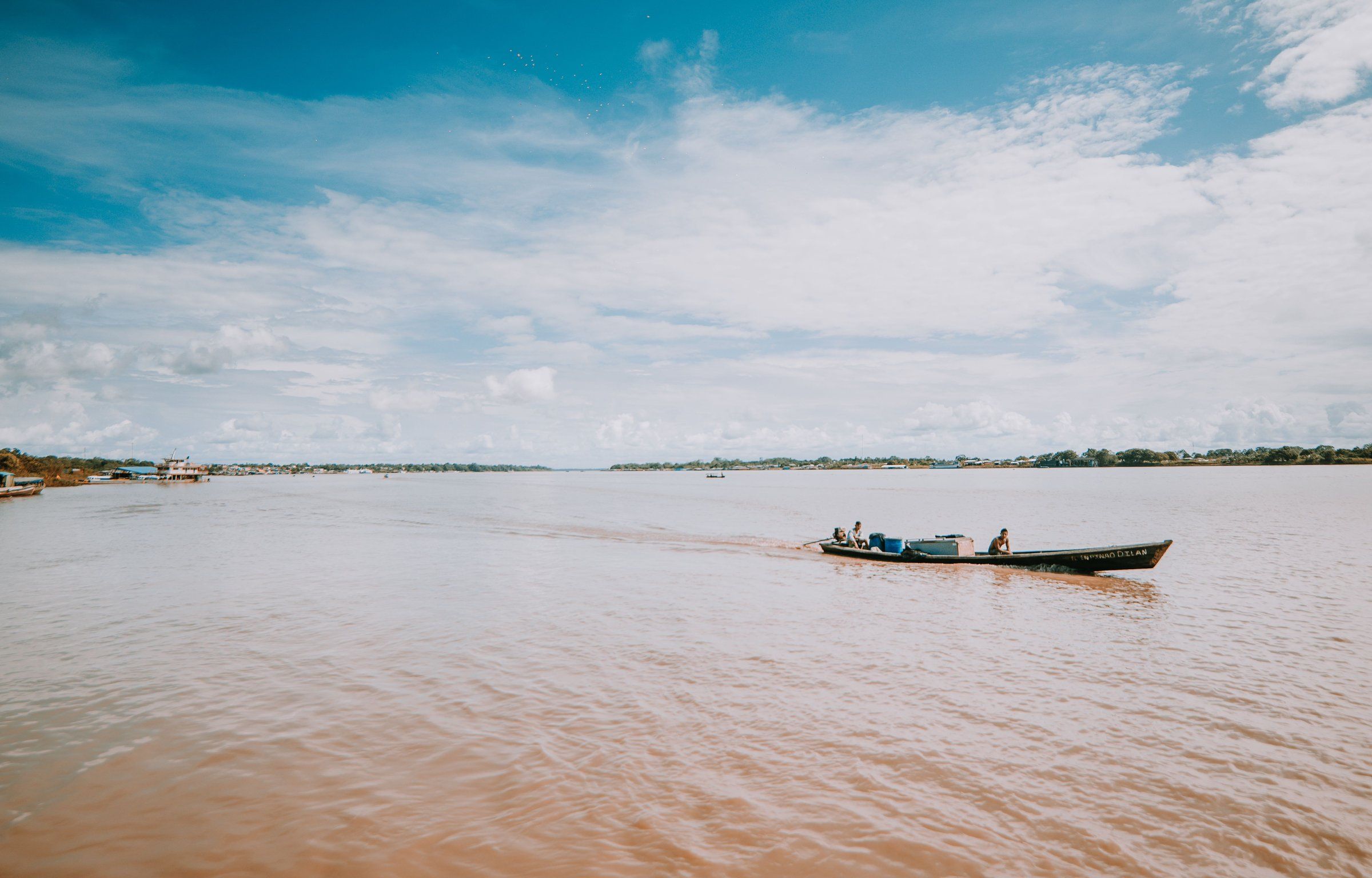
The river is the region’s real highway. Upstream from Leticia, along the Colombian bank, are the Indigenous communities of Macedonia, Mocagua and San Martín de Amacayacu, Amacayacu National Park and, about two hours away by speedboat, Puerto Nariño, where the Loretoyacu River joins the Amazon. The area is home mainly to the Ticuna, along with Cocama and Yagua people: much of the land along the river is Indigenous reserve (resguardo), which shapes how you visit it (more on that below).
A useful detail: Leticia, Tabatinga and Santa Rosa share the same time (UTC-5) all year round. If you carry on to Manaus, clocks there are an hour ahead.
How to get to Leticia
You can only reach Leticia by air: no road links it to the rest of Colombia. Alfredo Vásquez Cobo Airport (LET) is a few minutes from the centre.
- From Bogotá: direct flights with Avianca and LATAM, about 2 hours. LATAM’s published fares for autumn 2026 start at around 325,000 pesos one way; during Colombian holidays (December-January, Holy Week, mid-year) they climb fast, so book early.
- From Medellín, Cartagena, Cali and other cities: you’ll usually connect in Bogotá. If you’re flying in from the UK or the US, plan a night in Bogotá on the way in or out, so a delay doesn’t cost you the connection.
- From Peru: speedboats run from Iquitos to Santa Rosa in around 10-12 hours, a few days a week, with tickets paid in soles. Slower multi-day boats run too.
- From Brazil: from Manaus to Tabatinga there are slow hammock boats (5-7 days) and speedboats (around 30-36 hours, according to travellers), paid in reais. The FCDO advises against all but essential travel along this stretch of the Amazon, between Belém do Solimões and Codajás, so weigh that up. There are also flights from Tabatinga to Manaus.
From the airport a taxi or mototaxi gets you to the centre in minutes. According to Wikivoyage there’s no ATM at the airport, so arrive with pesos for the tax and the taxi.
Tourist tax and other arrival requirements
- Leticia tourist tax: paid in cash at the airport as soon as you land. Sources disagree on the amount: 2024 articles mention 35,000 pesos, while tour operators in 2025-2026 quote 45,000-50,000 pesos per person. I couldn’t find the town’s official 2026 rate, so have at least 50,000 pesos ready.
- Puerto Nariño tax: a separate charge of 10,000-20,000 pesos depending on the source (the most recent say 15,000-20,000), paid when you arrive in the village.
- Yellow fever: in the Colombian Ministry of Health’s table (April 2025), Leticia, Puerto Nariño and every municipality in Amazonas are rated high risk, and Colombia declared a health emergency in April 2025. Sources disagree about the certificate: the official pages I checked describe the vaccine as recommended, while some guides and tour operators say it’s checked on arrival in Leticia, at the national park or when crossing into Brazil, and Spain’s foreign ministry notes that Brazil requires it from travellers arriving from Colombia. Get vaccinated at least 10 days before and carry your International Certificate of Vaccination (the yellow card), and you’re covered either way. The rest is in our guide to Colombia entry requirements.
Tabatinga and Santa Rosa: crossing the border
For a day visit to Tabatinga, just cross the border street on foot, by taxi or by mototaxi: most guides say you don’t need a passport stamp if you stay in the border towns, but always carry your passport. Santa Rosa is a few minutes by boat from Leticia’s or Tabatinga’s docks.
If you’re travelling on into Brazil or Peru, get your exit stamp at the Migración Colombia office in Leticia, then report to the Polícia Federal in Tabatinga to enter Brazil, or to the immigration office in Santa Rosa for Peru. Hours and procedures change, so ask at your hotel the day before. Check the visa rules for your passport before going beyond the border towns: US citizens, for example, have needed an e-visa for Brazil since April 2025.
On money: Colombia uses pesos, Tabatinga reais and Santa Rosa soles. Shops near the border often take more than one currency, at poor rates; for a short visit a little cash is enough. Colombia and Peru have been in a diplomatic dispute over sovereignty of Santa Rosa island since 2025: so far it hasn’t changed anything for visitors.
Is Leticia safe? Travel advice and the border
Leticia is a calm town for visitors. The UK FCDO doesn’t advise against travel to Amazonas department, and the US State Department keeps it at Level 3 (“Reconsider travel”), like most of Colombia (advisory of March 31, 2026); Amazonas isn’t among the Level 4 areas.
The picture changes just over the border. The frontier is a corridor for drug trafficking, smuggling and illegal gold mining: according to a Global Initiative report, in 2023 Tabatinga had a homicide rate of about 96 per 100,000 people, against 31 in Leticia, and from October 26, 2026 Brazil sent its Força Nacional to reinforce border security for 90 days.
- US: Brazil’s advisory puts areas within 160 km (100 miles) of its land borders, Tabatinga included, at Level 4, and Peru’s advisory does the same for the Colombian-Peruvian border area in Loreto, where Santa Rosa lies.
- UK: the FCDO’s Peru advice warns against travel within 20 km south of the Putumayo River but makes an exception for the Amazon River and the triple border up to Santa Rosa; its Brazil advice doesn’t name Tabatinga.
In practice:
- Tabatinga and Santa Rosa are fine by day, for a stroll or lunch; in the evening, stay in Leticia.
- Don’t wander alone into Tabatinga’s outer neighbourhoods or along isolated riverbanks.
- For river trips use registered operators (see below) and don’t accept impromptu boat rides.
- The bigger picture is in our guide to safety in Colombia.
Things to do in Leticia and around
| What | Time | Indicative price |
|---|---|---|
| Parque Santander and the sunset parrots | 30-45 minutes | free |
| Museo Etnográfico (Banco de la República) | 1 hour | free |
| Riverside port and market | 1 hour | free |
| Tabatinga and Santa Rosa | half a day | Santa Rosa boat agreed on the spot |
| Reserva Tanimboca (canopy, kayaking) | half a day | ask the reserve |
| Amacayacu National Park and Mocagua | 1 day | 73,000 pesos for foreign visitors |
| Night caiman spotting | 2-3 hours | usually included in tours |
In town: parrots, museum and port
Leticia’s best moment is sunset in Parque Santander, the main square: around 5:30-6pm thousands of parrots fly in to roost in the park’s trees, making a deafening racket. It’s free; stand at the edges rather than under the trees, because the parrots will leave you a souvenir.
The Museo Etnográfico run by the Banco de la República tells the story of the Colombian Amazon’s peoples through objects, masks and instruments. Entry is free and some guides say it closes on Sundays, but official hours aren’t published, so check the Banco de la República page. Early in the morning, take a walk around the port and market: river fish (pirarucú, one of the world’s largest freshwater fish, often ends up on the menu), Amazonian fruit and boats coming and going.
Reserva Tanimboca
Reserva Natural Tanimboca is a private reserve about 11-13 km (7-8 miles) from Leticia, on the only road out of town. It offers a canopy walk and zip lines, kayaking and treehouse rooms if you want to stay. It’s a good pick if you’re short on time or want a half-day outing without a boat. I couldn’t find up-to-date prices in pesos, so ask the reserve directly.
Amacayacu National Park, Mocagua and San Martín
Amacayacu National Park, around an hour and a half upriver from Leticia, is the only one of the Colombian Amazon’s eleven national parks open to tourism. After the 2012 flood the old visitor centre closed, and today visits go through the Ticuna communities of Mocagua and San Martín de Amacayacu, which have their own ecotourism committees, local guides and a community fund paid for by visitors. You can do forest walks and canoe trips, and in San Martín you can stay in community-run guesthouses.
Park entry in 2026 costs 73,000 pesos for non-resident foreigners; Colombians and citizens of the Andean Community pay 27,500 pesos (15,000 if under 25). In Mocagua you’ll also find the Fundación Maikuchiga, which rescues monkeys taken from the wildlife trade: it’s the alternative I’d recommend to Monkey Island.
Isla de los Micos: why I’d skip it
Isla de los Micos (Monkey Island), about an hour by boat from Leticia, began in the 1960s as a monkey-breeding operation for the animal trade. Today tourists hand bananas to monkeys that climb all over them: biologists and conservation groups criticise this model because constant contact with people changes the animals’ behaviour and causes stress. It still features in many day trips to Puerto Nariño; if you can, pick a tour that leaves it out.
The same goes for some stops along the river, especially on the Peruvian side, where you’ll be offered photos holding sloths, snakes or caimans: don’t pay for them.
Giant water lilies, Marasha and night trips
Victoria regia water lilies, with leaves more than a metre (over 3 feet) across, grow in several lakes along the river: many trips stop at Puerto Alegría on the Peruvian side or at small private reserves. Also in Peru, Reserva Natural Marasha has a lake and forest trails; trips there are mostly sold in US dollars. Almost every lodge and multi-day tour includes a night boat trip to spot caimans and piranha fishing with bamboo rods: fun, but ask that nobody grabs a caiman for photos.
Puerto Nariño and Lake Tarapoto
Puerto Nariño is the second municipality of Amazonas, about 2 hours by speedboat from Leticia: a Ticuna village of colourful houses linked by concrete paths, with no cars. You can walk around it in an hour, the evenings are quiet and life follows the river. It’s the base for Lake Tarapoto and, to my mind, the place to spend at least one night.
Getting there: the speedboat from Leticia
Public speedboats leave Leticia’s port every day, with several departures between morning and early afternoon. One reseller lists departures around 9am, noon and 2pm from Leticia, and around 10am, 1:30pm and 3:30pm from Puerto Nariño, but schedules change: check at the company’s office at the port. The trip takes about 2 hours (an hour and three quarters according to some sources) and costs 35,000-42,000 pesos each way depending on the source, with a luggage limit of around 20 kg (44 lb).
- Buy your ticket the day before at the company offices by the port, especially at weekends and during Colombian holidays.
- Be there half an hour early: the boats leave on time.
- Boats stop on request at riverside communities such as Macedonia and Mocagua.
- Keep a light jacket and a dry bag handy: it’s breezy on the river and the spray reaches you.
At very low water the trip takes longer and boats have to dodge sandbanks: in 2023 and 2024 the river hit record lows, and in September 2026 Colombia’s Ombudsman’s Office (Defensoría del Pueblo) again reported low levels that made navigation in the area difficult. Between August and November, ask ahead whether services are running normally.
Lake Tarapoto and the pink river dolphins
The Tarapoto lakes, a wetland protected under the Ramsar Convention, are about 30 minutes by boat from Puerto Nariño. This is the easiest place in Colombia to see the pink river dolphin (Inia geoffrensis) and the grey river dolphin. At high water, roughly November-December to May, sightings are more frequent; at low water they’re harder.
Boat trips are arranged with village guides or your guesthouse. An El Espectador article quotes 20,000-50,000 pesos per person on a shared boat; one operator charges 100,000-200,000 pesos per person for a private trip, depending on group size. Allow 3-4 hours and go early, when the lake is calm. The rules are simple: engine off or idling near the dolphins, no feeding, no chasing.
The viewpoint, Natütama and Fundación Omacha
- Mirador: a wooden tower above the village with views over the river and forest. You enter through the mouth of a carved jaguar; it costs little and it’s the place for sunset.
- Natütama Centre: a small interpretation centre about the river’s ecosystem, with life-size wooden carvings of dolphins, manatees and fish, created with local communities. Entry is by donation; one guide says it’s closed on Tuesdays.
- Fundación Omacha: the organisation that has studied and protected river dolphins around Puerto Nariño since the 1990s. If you’re interested, ask in the village whether they’re running activities open to visitors.
The village has no banks or ATMs and few places take cards: bring cash from Leticia for the tax, accommodation, meals and boat trips. The internet is slow.
Indigenous communities: etiquette and who runs the tours
The river is home mainly to the Ticuna, along with the Cocama and Yagua, in communities with their own governing council (cabildo). Many tours pass through, but the money doesn’t always stay in the community: Parques Nacionales itself has flagged problems in how the ecotourism fund is managed, and in 2026 the Colombian press reported on unregulated tourism in the Amazon.
To choose well:
- Go for tours where the guide is from the community, or where the operator tells you clearly what it pays the community; many communities charge an entry contribution.
- Buy crafts directly from the people who make them: seed necklaces, chambira-fibre bags, wood carvings.
- Always ask before photographing people or homes.
- Be wary of “ceremonies” staged for tourists and of ayahuasca offers: they aren’t a cultural visit and they can be dangerous.
Amazon tours and jungle lodges
The easiest way to see the forest is a 3-5 day tour with nights at a lodge or in a community. They usually include speedboat transfers, accommodation, meals, a guide, day and night walks, canoeing, caiman spotting and piranha fishing; they almost never include the flight, the Leticia and Puerto Nariño taxes or park entry.
| Type of tour | Length | Indicative price |
|---|---|---|
| Puerto Nariño day trip (with Monkey Island) | 1 day | about 280,000 pesos per person, tax extra |
| Tour with Puerto Nariño, Tarapoto and a community | 4 days | from about 1,170,000-1,350,000 pesos per person |
| Jungle tour with camping or a lodge | 3 days | often sold in US dollars |
Choosing an operator: in Colombia every agency and guide must be listed on the Registro Nacional de Turismo (RNT, the national tourism register). Ask for the number and check it on the RNT portal, get in writing what’s included, how many people per guide and which language they speak, and be wary of offers from people at the port without an office. If you’d rather book online, tours from Leticia are in the box below.
Where to stay: Leticia, river lodges and Puerto Nariño
- Central Leticia: the most practical choice for your first and last nights, close to the port, banks and Parque Santander. You’ll find hostels, simple air-conditioned hotels and upmarket options such as the Decalodge Ticuna. Booking sites mostly show rates in US dollars: hostels are the budget option, while hotels with a pool cost several times as much.
- River and roadside lodges: forest lodges upstream from Leticia, on the Peruvian bank or along the road out of town (Tanimboca, for instance). They’re usually booked full board with excursions included, and the price depends mostly on how many outings you do.
- Puerto Nariño: family guesthouses, small hotels and eco-lodges with a handful of rooms, almost all a few minutes’ walk from the dock. Expect a fan more often than air conditioning, hot water rarely and slow internet.
- Communities such as San Martín de Amacayacu: community guesthouses and simple malocas, the most authentic choice if you don’t mind thin mattresses and mosquito nets.
How many days you need and a sample itinerary
You need 4-5 full days on the ground, plus flying time. With 3 days, choose between Puerto Nariño and a lodge; with 6-7, add the Amacayacu communities or another night in the forest.
- Day 1: fly in from Bogotá, pay the tax at the airport, check in downtown. Museo Etnográfico in the afternoon and the Parque Santander parrots at sunset.
- Day 2: Tabatinga and Santa Rosa in the morning (by day), Reserva Tanimboca or the port in the afternoon. Buy your speedboat ticket.
- Day 3: morning speedboat to Puerto Nariño, check in, viewpoint and Natütama, sunset over the river.
- Day 4: dawn boat trip on Lake Tarapoto for the dolphins; free afternoon or a forest walk with a local guide.
- Day 5: speedboat back to Leticia (stopping at Mocagua if you’ve arranged a visit) and a late-afternoon flight to Bogotá, or an extra night in Leticia.
Don’t book your return flight too early on the day you come back from Puerto Nariño: low water or a full boat can easily cost you an hour.
Best time to visit Leticia
Leticia is hot and humid all year, at about 100 metres (330 feet) above sea level, with highs of 31-32°C (88-90°F) and lows of 22-23°C (72-73°F), and it rains in every season. More than the rain, what matters is the river level, which shifts by several metres. Sources disagree on exact dates, but roughly:
- High water, roughly December to May: the forest floods, you canoe between the trees and dolphins are easier to spot.
- Low water, roughly August to October: beaches and trails appear and you walk more, but boats are slower and recent droughts have been exceptional.
The priciest weeks are Colombian holidays, when flights and rooms fill up. For other regions, see our guide to the best time to visit Colombia.
Practical matters: money, health, power and internet
- Cash: Leticia has ATMs downtown but, according to Wikivoyage, none at the airport; Puerto Nariño and the communities have none. Withdraw before heading upriver. Fees and cards are covered in our guide to money in Colombia.
- Health: besides yellow fever, the region has malaria and dengue. Ask a travel clinic whether you need antimalarials for your days on the river, use a strong insect repellent and sleep under a net. Leticia has a hospital, but serious cases are flown to Bogotá: travel insurance with medical evacuation is essential.
- Clothing: long sleeves and light quick-dry trousers, a poncho or rain jacket, closed shoes (lodges often lend rubber boots), a head torch, a hat and sunscreen.
- Water: drink bottled or filtered water, and use it to brush your teeth in the communities.
- Power: 110 volts with US-style plugs, as in the rest of Colombia (UK visitors need an adapter); some lodges only have power for a few hours a day.
- Internet: available in Leticia, slow in Puerto Nariño, often absent at lodges. Download maps and documents before you go.
How much does a trip to Leticia cost?
| Item | Indicative price |
|---|---|
| Bogotá-Leticia flight | from about 325,000 pesos one way (LATAM, autumn 2026) |
| Leticia tourist tax | 35,000-50,000 pesos depending on the source (most recent 45,000-50,000) |
| Leticia-Puerto Nariño speedboat | 35,000-42,000 pesos each way |
| Puerto Nariño tax | 10,000-20,000 pesos |
| Lake Tarapoto boat trip | 20,000-50,000 pesos shared, 100,000-200,000 private |
| Amacayacu National Park entry | 73,000 pesos for foreign visitors |
| 4-day tour with lodging and meals | from about 1,170,000 pesos per person |
| Museo Etnográfico, Parque Santander | free |
Mistakes to avoid
- Arriving without cash: the tax is paid in pesos the moment you land, and there’s no ATM at the airport.
- Heading to Puerto Nariño without withdrawing money: there are no ATMs in the village.
- Staying only in Leticia and doing everything as day trips: you’ll spend the best hours on a boat.
- Booking a tour at the port without asking for the RNT number and what’s included.
- Paying for photos with animals or feeding monkeys.
- Going out at night in Tabatinga or accepting boat rides from strangers.
- Forgetting your yellow fever vaccine or certificate.
- Booking a tight return flight after the speedboat from Puerto Nariño.
FAQ
How do you get to Leticia?
Only by air: Avianca and LATAM fly direct from Bogotá in about 2 hours. No roads connect Leticia to the rest of Colombia; from Peru and Brazil you can also arrive by boat, from Iquitos or Manaus.
How much is the Leticia tourist tax?
Sources disagree: between 35,000 and 50,000 pesos per person, with the most recent figures, from 2025-2026, around 45,000-50,000 pesos. You pay it in cash at the airport on arrival; Puerto Nariño charges another 10,000-20,000 pesos.
Do I need a yellow fever vaccine for Leticia?
It’s strongly recommended, because every municipality in Amazonas is rated high risk. Sources disagree on whether the certificate is compulsory, so get vaccinated at least 10 days before and carry your International Certificate of Vaccination: that way you’re covered on arrival and at the Brazilian border.
Where can you see pink river dolphins in Colombia?
The easiest place is Lake Tarapoto, 30 minutes by boat from Puerto Nariño, which is itself about 2 hours by speedboat from Leticia. They’re seen more often at high water, roughly December to May.
Can you visit Brazil and Peru from Leticia?
Yes: Tabatinga in Brazil is joined to Leticia and you can walk there; Santa Rosa in Peru is a few minutes away by boat. For a day visit you usually don’t need a stamp, but carry your passport; if you’re travelling further, get an exit stamp from Migración Colombia in Leticia. In the evening, stay on the Colombian side.
Some links are affiliate links: if you buy through them I earn a small commission, at no extra cost to you. How it works
You might also like
Caribbean coast
La Guajira: Cabo de la Vela and Punta Gallinas
La Guajira, Colombia's Wayuu desert that runs into the Caribbean: Cabo de la Vela and Punta Gallinas tours from Riohacha, prices, where to stay and safety.
Caribbean coast
Palomino
Palomino, Colombia: float a jungle river from the Sierra Nevada down to the Caribbean. Tubing prices, buses from Santa Marta, safe swimming and where to stay.
Caribbean coast
Providencia
Providencia and Santa Catalina, Colombia's quiet Raizal islands 90 km from San Andrés: flight or catamaran, Crab Cay, El Pico hike, beaches and where to stay.