Discover Colombia
Football in Colombia: league, clubs, stadiums and the national team
Football in Colombia: how the Liga BetPlay works, the big clubs and clásicos, how to buy match tickets and the story of the Colombian national team.
In this guide
- Football in Colombia: much more than a sport
- A short history of Colombian football
- How the Colombian football league works
- The biggest football clubs in Colombia
- The clásicos: Colombian football’s fiercest rivalries
- Barras and atmosphere: what Colombian stadiums are like
- Colombia’s most important football stadiums
- How to watch a football match in Colombia: practical guide
- The Colombia national football team
- The most famous Colombian footballers of all time
- Women’s football in Colombia
- A short glossary of Colombian football
- Why it’s worth experiencing football in Colombia
- FAQ
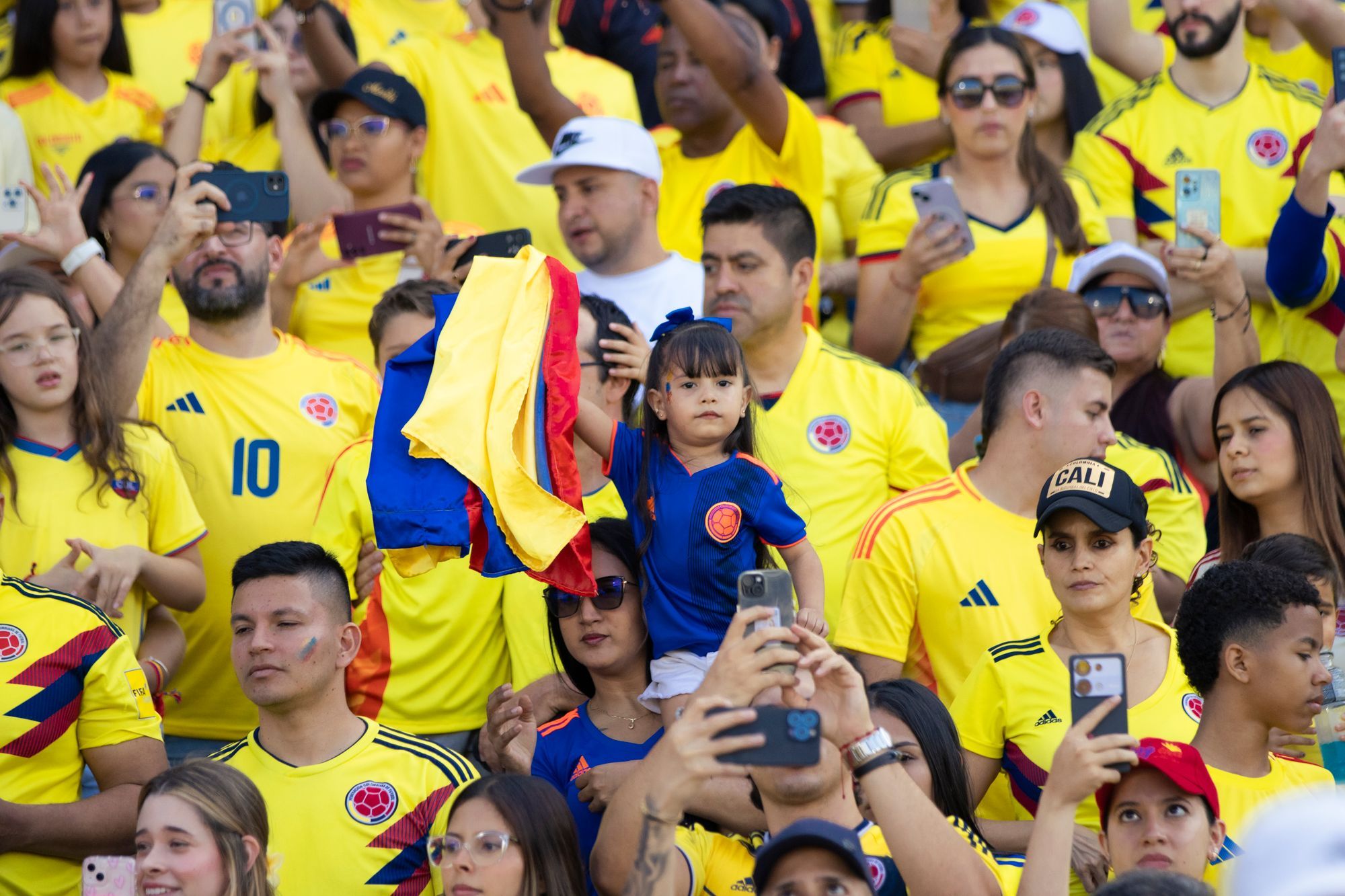
If one thing can bring all of Colombia together, from the Caribbean coast to the Andes and from the Pacific to the eastern plains, it’s the ball. Football in Colombia is by far the most followed sport, but calling it just a sport sells it short: it’s the favourite topic with taxi drivers, an identity for every neighbourhood and city, and the reason a whole country dresses in yellow when the Selección takes the field.
In this guide I cover everything you need to know about Colombian football: how it started, how the league works, the biggest clubs and fiercest rivalries, how to buy tickets to watch a match live and, of course, the history, records and current state of the Colombia national football team. You’ll also find a look back at the 2026 World Cup in North America and the latest news, such as James Rodríguez’s farewell to the national shirt.
Football in Colombia: much more than a sport
In Colombia football is everywhere. You’ll see it on the dirt pitches of working-class neighbourhoods, in games of microfútbol (Colombia’s version of five-a-side, played on concrete with a smaller, heavier ball that barely bounces) and in neighbourhood tiendas, where people gather in front of the TV in the evening with a cold beer to talk over the latest round.
Support is deeply local. Every big city has its own teams and rivalries: in Bogotá people are split between Millonarios and Santa Fe, in Medellín between Atlético Nacional and Independiente Medellín, in Cali between América and Deportivo Cali, while Barranquilla and much of the coast support Junior.
For a Colombian, your team is inherited from your family and never changes: asking “¿de qué equipo eres?” (which team do you support?) is one of the easiest ways to break the ice.
A fun fact: by law (Law 613 of 2000) Colombia’s national sport isn’t football but tejo, a game of indigenous origin in which you throw a metal disc at a clay target holding small gunpowder charges that explode on impact. Football is still, without question, the most played and followed sport in the country.
When the Selección plays
When the national team plays, Colombia stops. The camiseta amarilla (yellow shirt) appears in offices, schools and on public transport, restaurants set up big screens and the streets empty for ninety minutes, then fill with car horns, flags and music if Colombia wins. Many Colombians will tell you bluntly: the Selección is one of the few things that can unite a country that disagrees on almost everything else.
A short history of Colombian football
The origins and the first professional league
Football reached Colombia in the early 20th century, brought by foreign sailors, traders and engineers through the Caribbean ports: it’s no coincidence that Barranquilla is considered one of the cradles of Colombian football. The first national federation was founded in 1924, but for decades the game stayed amateur and split into regional tournaments.
The turning point came in 1948 with the creation of DIMAYOR (División Mayor del Fútbol Profesional Colombiano) and the first professional league, won by Independiente Santa Fe of Bogotá. Since then DIMAYOR has run the professional club competitions, while the Federación Colombiana de Fútbol (FCF) runs the national teams.
El Dorado (1949-1954): when Colombia bought the stars
Soon after the professional league began, a dispute between DIMAYOR and the federation led FIFA to suspend Colombia. Paradoxically, it was the start of a golden age: outside international rules, Colombian clubs could sign foreign stars without paying their former clubs, offering huge salaries. The period is remembered as El Dorado.
The symbol of those years is Millonarios, nicknamed the “Ballet Azul” for its spectacular style, starring Argentines Alfredo Di Stéfano, Adolfo Pedernera and Néstor Rossi. With the so-called Lima Pact of 1951 things gradually returned to normal, and in 1954 the foreign players went back to their original clubs. The price was high: the national team didn’t play from 1949 to 1957.
The 1980s and 1990s: talent, triumphs and wounds
In the 1980s Colombian football grew fast. América de Cali dominated the league with five titles in a row between 1982 and 1986 and played three straight Copa Libertadores finals, losing all of them. In 1989 Francisco Maturana’s Atlético Nacional became the first Colombian team to win the Libertadores, with René Higuita in goal and a squad made up entirely of Colombian players.
It was also the most controversial period: many journalistic investigations have documented how drug-trafficking money found its way into several clubs of the time. The deepest wound came in 1994 with the murder of national team defender Andrés Escobar, a tragedy I cover below in the section on the Selección.
From the new millennium to today
Since 2002 the league has been played as two short tournaments a year, and Colombian clubs have stayed competitive in South America: Once Caldas won the 2004 Libertadores against the odds, beating Boca Juniors on penalties, Independiente Santa Fe won the 2015 Copa Sudamericana and Atlético Nacional lifted its second Libertadores in 2016. Meanwhile Colombia became one of the great exporters of talent to Europe, Mexico and the United States.
In November 2016 the plane carrying Brazil’s Chapecoense to Medellín for the Copa Sudamericana final against Atlético Nacional crashed shortly before landing. Nacional asked CONMEBOL to award the trophy to the Brazilian club, a gesture that earned it fair play awards around the world. In Medellín the memory of that night is still strongly felt.
How the Colombian football league works
The top flight is officially called Categoría Primera A, but everyone knows it as the Liga BetPlay DIMAYOR, after its sponsor. It has 20 teams and, unlike most European leagues, two separate championships are played every year: the Torneo Apertura (January to June) and the Torneo Finalización (July to December). The result: Colombia has two champions every year.
Each title is called an estrella (star), which is why you’ll hear fans counting their club’s stars. The league’s all-time top scorer is Dayro Moreno, who has passed 260 Primera A goals in a career of more than twenty years.
The format: league phase, cuadrangulares and final
In the classic format the first phase is a single round-robin (todos contra todos), after which the top eight go into the cuadrangulares semifinales: two groups of four teams playing home and away. The two group winners then meet in a two-legged final.
The format can change from year to year, though. In 2026, to finish the Torneo Apertura before the World Cup, DIMAYOR replaced the cuadrangulares with knockout rounds, while the Torneo Finalización went back to the group format. Also from 2026, the four foreign players each team can register are allowed on the pitch at the same time.
Relegation: the “tabla del descenso”
In Colombia relegation doesn’t go to the bottom teams of the season, but to the two teams with the worst points average over the last three seasons: the tabla del descenso, a system that protects historic clubs from a single bad year. Relegated teams drop into Primera B, officially the Torneo BetPlay DIMAYOR, which has 16 teams; the top two go up to Primera A. In 2025, for example, Envigado and Unión Magdalena went down.
Copa Colombia, Superliga and international cups
Besides the league, the calendar includes the Copa Colombia, the national cup that’s also open to Primera B teams, where the most successful club is Atlético Nacional, and the Superliga, a kind of Super Cup between the previous year’s Apertura and Finalización champions: Santa Fe won the 2026 edition and, with five titles, is the king of this competition.
The best clubs then qualify for the Copa Libertadores and the Copa Sudamericana, CONMEBOL’s two continental club competitions. Libertadores places go to the Apertura and Finalización champions and to the best-placed teams in the tabla de reclasificación, the table that adds up points over the whole season. The other places, for the Sudamericana, are decided by the same table and the Copa Colombia.
Recent Liga BetPlay champions
- 2026-I (Apertura): Junior, who beat Atlético Nacional in the final (3-0 in Barranquilla and 0-1 in Medellín) to win two titles in a row.
- 2025-II (Finalización): Junior, 4-0 on aggregate against Deportes Tolima.
- 2025-I (Apertura): Independiente Santa Fe, for their tenth star.
- 2024-II (Finalización): Atlético Nacional, the eighteenth title in their history.
- 2024-I (Apertura): Atlético Bucaramanga, for their first ever league title.
The 2026 Torneo Finalización started in late July and ends with the final in December.
The biggest football clubs in Colombia
There are historic clubs in almost every big city, but the Colombian teams that have shaped the country’s football history are mainly seven or eight. Here’s a summary with their league titles.
| Club | City | League titles | Nicknames | Stadium |
|---|---|---|---|---|
| Atlético Nacional | Medellín | 18 | Verdolaga, Rey de Copas | Atanasio Girardot |
| Millonarios | Bogotá | 16 | Embajador, Albiazules | El Campín |
| América de Cali | Cali | 15 | Diablos Rojos, La Mechita | Pascual Guerrero |
| Junior | Barranquilla | 12 | Tiburón, Rojiblancos | Metropolitano Roberto Meléndez |
| Independiente Santa Fe | Bogotá | 10 | León, Cardenales | El Campín |
| Deportivo Cali | Cali | 10 | Azucareros, Verdiblancos | Estadio Deportivo Cali |
| Independiente Medellín | Medellín | 6 | DIM, Poderoso de la Montaña | Atanasio Girardot |
| Once Caldas | Manizales | 4 | Blanco Blanco | Palogrande |
| Deportes Tolima | Ibagué | 3 | Pijao, Vinotinto y Oro | Manuel Murillo Toro |
Atlético Nacional (Medellín)
The most successful club in Colombia, with 18 league titles, two Copa Libertadores (1989 and 2016) and the record number of Copa Colombia wins. The “Verdolaga” plays in green and white at the Atanasio Girardot stadium and has one of the biggest fan bases in the country, led by the barra Los del Sur. In September 2026 it signed James Rodríguez, who came back to play in Colombia.
Millonarios (Bogotá)
Founded in 1946, Millonarios is the club of the El Dorado era and Di Stéfano’s Ballet Azul. With 16 league titles it’s the country’s second most successful team, and its latest star came in 2023, beating Atlético Nacional in the first ever final between the two clubs. It plays in blue and white at El Campín, is nicknamed “El Embajador” and its main barra is the Comandos Azules. In early 2026 it was the club with the most season-ticket holders in the country, with more than 25,000 sold.
América de Cali
The “Diablos Rojos” have 15 league titles, five of them in a row between 1982 and 1986. América de Cali’s history is one of great highs and dramatic falls: four lost Libertadores finals (1985, 1986, 1987 and 1996) and relegation to Primera B in 2011, followed by a return to the top flight and the titles of 2019 and 2020. Its best-known barra is the Barón Rojo Sur.
Junior de Barranquilla
The “Tiburón” (shark) is the Caribbean coast’s team and the reigning champion: with the 2025-II and 2026-I titles it has reached 12 league titles. Some of Colombia’s best-loved players have worn Junior’s red and white stripes, from Carlos Valderrama to Luis Díaz. Its best-known organised fan group is the Frente Rojiblanco Sur.
Independiente Santa Fe (Bogotá)
The “León”, or “Cardenal”, was the first champion of Colombian professional football in 1948 and now has 10 league titles. Santa Fe is the only Colombian club to have won the Copa Sudamericana (2015) and the Suruga Bank Championship (2016), and holds the record for Superliga titles. It shares El Campín with Millonarios and its barra is La Guardia Albi Roja Sur.
Deportivo Cali
Deportivo Cali, the “Verdiblancos” or “Azucareros”, has won 10 league titles and is one of the few Colombian clubs that owns its stadium, the Estadio Deportivo Cali, in Palmira near the city’s airport. It’s known for its youth academy, and its main barra is the Frente Radical Verdiblanco.
Independiente Medellín
“DIM”, nicknamed “El Poderoso de la Montaña”, is one of the oldest clubs in the country (founded in 1913) and has won 6 league titles. Independiente Medellín shares the Atanasio Girardot with Atlético Nacional and its barra is the Rexixtenxia Norte.
Once Caldas, Tolima and the rest
Outside the three big cities, Once Caldas of Manizales deserves a mention, with 4 league titles and that astonishing 2004 Libertadores, as does Deportes Tolima of Ibagué, with 3 titles. In recent years clubs such as Deportivo Pereira (2022) and Atlético Bucaramanga (2024) have also celebrated their first league title: a sign of a balanced league, where almost any season can bring a surprise.
The clásicos: Colombian football’s fiercest rivalries
In Colombia a derby is called a clásico, and every region has its own. These are the most awaited games of the season, when stadiums fill up and tickets sell out.
- Clásico capitalino (or bogotano): Millonarios vs Independiente Santa Fe, the Bogotá derby.
- Clásico paisa: Atlético Nacional vs Independiente Medellín, the derby of Medellín and all of Antioquia.
- Clásico vallecaucano: América de Cali vs Deportivo Cali, one of the tensest and most heartfelt derbies in the country.
- Clásico costeño: Junior vs Unión Magdalena, the Caribbean coast showdown between Barranquilla and Santa Marta.
- Other regional clásicos: the Clásico del Oriente (Cúcuta Deportivo vs Atlético Bucaramanga), the Clásico cafetero (between Once Caldas, Deportivo Pereira and Deportes Quindío) and the Clásico del Tolima Grande (Deportes Tolima vs Atlético Huila).
Nationally, the most prestigious fixture is Atlético Nacional vs Millonarios, the two most successful clubs: for many it’s the great classic of Colombian football, because it also pits the country’s two most important cities, Bogotá and Medellín, against each other.
Barras and atmosphere: what Colombian stadiums are like
The heart of Colombian fandom is the barras, the organised fan groups that fill the ends of the ground, called tribuna Norte and tribuna Sur. The model is Argentine: they sing for the full ninety minutes with drums and trumpets, unfurl huge flags and banners (trapos) and prepare spectacular displays for big games.
The best-known barras include Los del Sur (Atlético Nacional), Comandos Azules (Millonarios), La Guardia Albi Roja Sur (Santa Fe), Barón Rojo Sur (América), Frente Radical Verdiblanco (Deportivo Cali), Rexixtenxia Norte (Independiente Medellín) and Frente Rojiblanco Sur (Junior).
The other side of the coin is violence, which has marked Colombian football in the past and still resurfaces at times. That’s why the authorities have brought in stricter controls, such as named tickets linked to an ID document, and support so-called barrismo social, an approach that aims to involve the barras in social and cultural projects in their neighbourhoods.
Colombia’s most important football stadiums
Colombian stadiums aren’t always modern, but almost all of them have a story to tell and an atmosphere that’s hard to forget. These are the main ones.
| Stadium | City | Home teams | Good to know |
|---|---|---|---|
| Nemesio Camacho “El Campín” | Bogotá | Millonarios, Santa Fe | At over 2,600 metres (8,500 ft), it hosted the 2001 Copa América final |
| Atanasio Girardot | Medellín | Atlético Nacional, Independiente Medellín | Easy to reach by metro, Estadio station (line B) |
| Metropolitano Roberto Meléndez | Barranquilla | Junior, Colombia national team | Being expanded to over 60,000 seats, hosts the 2026 Copa Sudamericana final |
| Pascual Guerrero | Cali | América de Cali | The city’s historic stadium, opened in 1937 |
| Estadio Deportivo Cali | Palmira (Cali metro area) | Deportivo Cali | Owned by the club, near the airport |
| Palogrande | Manizales | Once Caldas | Scene of the 2004 Libertadores triumph |
The Metropolitano in Barranquilla is the national team’s usual home, where it plays its qualifiers: the humid coastal heat has always been seen as an advantage against visiting teams. In 2026 the stadium underwent a major expansion taking capacity from about 43,000 to over 60,000 seats; during the works Junior played at the nearby Romelio Martínez stadium, and the Selección played its pre-World Cup farewell friendly at El Campín in Bogotá.
How to watch a football match in Colombia: practical guide
Going to a game is one of the best experiences you can have in Colombia, even if you’re not a big fan. Here’s how to see a football match in Colombia without any nasty surprises.
When matches are played
The Torneo Apertura usually runs from late January to June and the Finalización from July to December, so the finals are played in June and December, the most exciting moments of the year. Liga BetPlay games are mostly played at weekends, with some midweek rounds, often in the evening. The official fixture list is published on the DIMAYOR website (dimayor.com.co) and on the clubs’ social media, but final dates and kick-off times are usually confirmed only a few days ahead.
How to buy tickets
In Colombia tickets are called boletas and are almost always bought online, through the official ticketing platforms each club lists on its website or social media: Atlético Nacional, for example, has its own platform called Tribuna Verde.
Since 2022 a national regulation (Decree 1622) has required match tickets to be linked to the buyer’s ID, with a maximum of five tickets per person, and the ID is checked at the entrance. As a foreigner you’ll normally need your passport both when you buy and at the turnstiles.
For regular-season games you can usually find seats a few days before, but for clásicos, play-offs and national team matches it’s worth moving well in advance, as sections sell out fast. To give you an idea of prices: for the 2026 Torneo Apertura semi-finals, Atlético Nacional tickets cost between 95,000 and 396,000 pesos and Junior tickets between 65,000 and 217,000 pesos, before fees. Regular-season prices are generally lower.
Which section to choose
Colombian stadiums almost always follow the same layout: the tribuna Occidental is the main stand, the most comfortable and the most expensive; the tribuna Oriental opposite is a good middle ground; the Norte and Sur ends belong to the barras, with the cheapest tickets but also the most intense atmosphere. For your first game I’d go for Occidental or Oriental: you get a good view of the pitch and can enjoy the show in the ends from a safe distance.
What to bring (and what to leave at the hotel)
There are several rings of security checks with pat-downs at the entrance, so arrive at least an hour early. Bring the ID you used to buy the ticket, the ticket on your phone and little else.
Many stadiums ban belts with metal buckles, sharp objects, flares and bags with metal parts, but the rules vary by stadium and by match, so check the club’s instructions. If you’re going to El Campín in the evening, bring a jacket and a rain jacket: in Bogotá, at over 2,600 metres, evenings are cool and rain is frequent. To get back at night, use a taxi booked through an app: more tips are in the guide to safety in Colombia.
The organised tour: the easiest option for your first time
If you don’t speak Spanish or don’t want to organise everything yourself, in both Bogotá and Medellín there are organised tours that include the ticket, return transport and a guide: they cost more than doing it yourself, but take away all the worry about named tickets, sections and getting back to your hotel. In Medellín, for example, there’s a match at the Atanasio Girardot with a local guide, with an Atlético Nacional or Independiente Medellín home game depending on the date.
Where to watch on TV and streaming
In Colombia the Liga BetPlay is shown on Win Sports and the pay channel Win+ Fútbol, which is also available for streaming. National team matches are free-to-air on the national channels Caracol TV and RCN, which is one reason bars and restaurants fill up every time the Selección plays.
The Colombia national football team
The Selección Colombia is the country’s men’s national football team, run by the Federación Colombiana de Fútbol and affiliated to CONMEBOL. The players are nicknamed Los Cafeteros, a nod to Colombian coffee, but you’ll also often hear La Tricolor (the nickname comes from the flag of Colombia) or simply La Sele. It plays in the unmistakable yellow shirt and hosts its most important home games in Barranquilla.
| National team fact file | |
|---|---|
| Federation | Federación Colombiana de Fútbol (FCF) |
| Confederation | CONMEBOL |
| Nicknames | Los Cafeteros, La Tricolor |
| Head coach | Néstor Lorenzo (since 2022) |
| Main stadium | Metropolitano Roberto Meléndez, Barranquilla |
| First official match | 10 February 1938, against Mexico in Panama |
| World Cup appearances | 7 (1962, 1990, 1994, 1998, 2014, 2018, 2026) |
| Best World Cup result | Quarter-finals (2014) |
| Main trophy | Copa América 2001 |
| Most caps | James Rodríguez (131) |
| Top scorer | Radamel Falcao (36 goals) |
The national team’s most important trophy is the 2001 Copa América, won at home with six wins out of six and without conceding a goal. At the World Cup its best result is still fifth place overall in 2014, going out in the quarter-finals to Brazil.
Early days and the first World Cup (1938-1962)
Colombia played its first official match on 10 February 1938 against Mexico, at the Central American and Caribbean Games in Panama. The early years were hard, not least because the national team didn’t play between 1949 and 1957 due to the El Dorado suspension. Its first World Cup qualification came as a surprise in 1962 in Chile: Colombia went out in the first round, but grabbed a historic 4-4 draw against the Soviet Union of legendary goalkeeper Lev Yashin.
In that 4-4, Marcos Coll scored directly from a corner, beating Yashin himself. In Spanish this kind of goal is called a gol olímpico, and Coll’s is remembered as the only one ever scored at a World Cup finals.
The golden generation: Valderrama, Higuita and 5-0 in Buenos Aires
With Francisco Maturana as coach, the best-loved generation ever emerged in the late 1980s and early 1990s: Carlos el Pibe Valderrama, sweeper-keeper René Higuita, Leonel Álvarez, Freddy Rincón, Andrés Escobar and, a little later, Faustino Asprilla.
At Italia ‘90 Colombia returned to the World Cup after 28 years: at San Siro it drew 1-1 with West Germany, the eventual world champions, thanks to a stoppage-time goal by Rincón, then went out in the round of 16 in Naples against Roger Milla’s Cameroon, after a risky dash out of goal by Higuita.
On 5 September 1993 came the most famous match in Colombian history: the 5-0 win over Argentina at the Monumental in Buenos Aires, with braces from Rincón and Asprilla and a goal from Adolfo Valencia, securing direct qualification for USA ‘94.
That Colombia team set off with big ambitions, but the American World Cup ended in the first round. On 2 July 1994, a few days after returning home, Andrés Escobar, who had scored an own goal against the United States, was shot dead in Medellín: a tragedy that is still an open wound for the country. After France ‘98, also ending in the first round, Colombia began a long absence from the World Cup.
The 2001 Copa América: triumph at home
In 2001 Colombia hosted the Copa América and won it perfectly: six games, six wins, no goals conceded. In the final at El Campín in Bogotá, a header from Iván Córdoba (the team’s captain) beat Mexico 1-0.
It’s still the biggest title in the history of the Colombian national team, but it wasn’t enough to start a new era: Colombia failed to qualify for three World Cups in a row (2002, 2006 and 2010).
The Pékerman era: the 2014 World Cup and James’s magic
With Argentine José Pékerman as coach (2012-2018), Colombia returned to the World Cup in Brazil in 2014, even without the injured Radamel Falcao. It won its group with maximum points, knocked out Uruguay in the round of 16 and lost in the quarter-finals to hosts Brazil (2-1): its best result ever, along with the group dances after every goal that won over fans around the world.
The star was James Rodríguez, the tournament’s top scorer with 6 goals, who scored the Puskás Award-winning goal of the year against Uruguay. Four years later, in Russia, the run ended in the round of 16, on penalties against England.
The Lorenzo era: the 2024 Copa América final and the 2026 World Cup
After missing out on Qatar 2022, the job went to Argentine Néstor Lorenzo, formerly Pékerman’s assistant. Under him Colombia put together 28 games unbeaten, with prestigious friendly wins over Germany (2023) and Spain (2024) and, above all, a 2-1 win over Brazil in Barranquilla in November 2023, with two goals from Luis Díaz.
At the 2024 Copa América in the United States it reached the final, losing 1-0 after extra time to Argentina in Miami, with James Rodríguez named player of the tournament. In qualifying for the 2026 World Cup Colombia finished third with 28 points, signing off the South American group with a spectacular 6-3 win in Venezuela featuring four goals from Luis Javier Suárez.
At the 2026 World Cup in the United States, Mexico and Canada, drawn in Group K, Colombia beat Uzbekistan 3-1 at the Azteca in Mexico City and DR Congo 1-0 in Guadalajara, drew 0-0 with Portugal in Miami and beat Ghana 1-0 in the round of 32. In the round of 16 in Vancouver, a 0-0 draw with Switzerland after 120 minutes led to penalties, lost 4-3. Colombia went home unbeaten, with three wins and two draws, finishing the tournament in tenth place.
Colombia’s World Cup results
| Edition | Host | Result |
|---|---|---|
| 1962 | Chile | Group stage |
| 1990 | Italy | Round of 16 |
| 1994 | United States | Group stage |
| 1998 | France | Group stage |
| 2014 | Brazil | Quarter-finals |
| 2018 | Russia | Round of 16 |
| 2026 | United States, Mexico and Canada | Round of 16 |
Selección records and numbers
The record for caps for Colombia belongs to James Rodríguez, who reached 131 in the World Cup round of 16 against Switzerland, overtaking goalkeeper David Ospina (130). Next come Juan Guillermo Cuadrado (116), Carlos Valderrama (111) and Radamel Falcao (105).
The all-time top scorer is Radamel Falcao with 36 goals, ahead of James himself with 31. Colombia’s best FIFA ranking is 3rd, reached several times between 2013 and 2016.
On 15 September 2026, in a video posted on social media, James Rodríguez announced his retirement from international football after almost fifteen years in the yellow shirt. The captain won’t play at the 2028 Copa América: his departure closes the chapter of the 2014 generation for good.
The present and future of the national team
On 23 July 2026 the federation renewed Néstor Lorenzo’s contract; his first cycle ended with 51 games, 31 wins, 12 draws and 8 defeats. The new cycle starts with the September-October 2026 international friendlies and looks ahead to the 2028 Copa América and qualifying for the 2030 World Cup.
With James gone, the baton passes to a generation already established in Europe, led by Luis Díaz and including players such as Richard Ríos, Jhon Arias, Daniel Muñoz, Jhon Lucumí, Luis Javier Suárez and Gustavo Puerta.
The most famous Colombian footballers of all time
Colombia has given world football some of the most spectacular and recognisable players of the last forty years. These are the Colombian footballers you need to know.
- Carlos Valderrama: the ultimate icon, with his curly blond hair and extraordinary vision; twice South American Footballer of the Year (1987 and 1993).
- René Higuita: an eccentric, spectacular goalkeeper, famous for dribbling out of his area and for the “scorpion kick” save at Wembley in 1995.
- Faustino Asprilla: an unpredictable, explosive striker, idol of Parma and a star in the Premier League with Newcastle.
- Freddy Rincón: a powerful, complete midfielder who moved from Napoli to Real Madrid in the mid-1990s.
- Iván Córdoba and Mario Yepes: two defensive pillars and Selección captains, both long-time stars of Italy’s Serie A.
- Radamel Falcao: “El Tigre”, goal machine for Porto, Atlético Madrid and Monaco and the national team’s all-time top scorer.
- James Rodríguez: the best-loved number 10 of the last decade, with spells at Real Madrid and Bayern Munich.
- Juan Guillermo Cuadrado and David Ospina: two mainstays of the Selección for over a decade, with long careers in Europe’s top leagues.
- Luis Díaz: a winger who came through Junior’s ranks, now the face of the new Colombia and one of the best Colombian forwards ever.
Colombians in Italy’s Serie A
Italian football has a special bond with Colombia, because Serie A has hosted many cafeteros. In the 1990s Faustino Asprilla thrilled Parma, Freddy Rincón played for Napoli and Iván Córdoba became an Inter legend for more than a decade.
In the years that followed came Mario Yepes (Chievo, Milan and Atalanta), Fredy Guarín at Inter, Juan Camilo Zúñiga, Pablo Armero and David Ospina at Napoli, Carlos Bacca at Milan, Juan Guillermo Cuadrado at Fiorentina, Juventus and Inter, Luis Muriel and Duván Zapata, stars of Gasperini’s Atalanta, and Jhon Lucumí at Bologna.
Women’s football in Colombia
In recent years Colombian women’s football has grown enormously. The Liga Femenina BetPlay, founded in 2017, is the women’s professional league (Deportivo Cali won the 2025 title), while the women’s national team reached the quarter-finals of the 2023 World Cup and the final of the 2025 Copa América Femenina, lost on penalties to Brazil after an incredible 4-4. The face of this generation is Linda Caicedo, one of the most talented young players in world football.
A short glossary of Colombian football
A few words you’re sure to hear at the stadium or in a bar, useful for following a match and chatting about fútbol with Colombians.
| Word | Meaning |
|---|---|
| Hincha / hinchada | fan / fans |
| Barra | organised fan group, similar to ultras |
| Boleta / boletería | ticket / ticket office |
| Abono | season ticket |
| Estrella | league title won |
| Clásico | derby |
| Cancha | pitch |
| Arquero | goalkeeper |
| DT (director técnico) | coach, manager |
| Golazo | spectacular goal |
| Picado or picadito | kickabout with friends |
| Descenso / ascenso | relegation / promotion |
Why it’s worth experiencing football in Colombia
If you’re planning a trip to Colombia and love football, my advice is to fit at least one match into your itinerary. Ninety minutes at El Campín, the Atanasio Girardot or the Metropolitano are enough to understand how closely football in Colombia is tied to the country’s identity, with chants, flags, empanada sellers and a passion that cuts across social divides.
And if you’re in Colombia on a day the Selección plays, buy a national team shirt and let yourself be swept up by the atmosphere you’ll find in every Colombian city.
FAQ
Which is the most successful football club in Colombia?
Atlético Nacional of Medellín, with 18 league titles, two Copa Libertadores (1989 and 2016) and the Copa Colombia record. Next come Millonarios with 16 league titles and América de Cali with 15.
How do you buy tickets for a football match in Colombia?
Online, through each club’s official ticketing platform. Tickets are issued in your name (Decree 1622 of 2022), up to five per person: foreigners need their passport both to buy them and to get into the stadium.
How much does a football ticket cost in Colombia?
It depends on the match and the section: for the 2026 Apertura semi-finals, prices ranged from 95,000 to 396,000 pesos for Atlético Nacional and from 65,000 to 217,000 pesos for Junior, before fees. Regular-season prices are lower.
Has Colombia ever won a major trophy?
Yes, the 2001 Copa América, won at home with six wins out of six and no goals conceded. At the World Cup its best result is the quarter-finals in Brazil in 2014.
Why is the Colombian national team called Los Cafeteros?
It’s a tribute to coffee, Colombia’s signature product. The team is also called La Tricolor, after the colours of the flag, or simply La Sele.
More about Colombia
Discover Colombia
The flag of Colombia: colours, meaning and history
The flag of Colombia: why yellow fills half the flag, what the colours mean, where the tricolour comes from and when you'll see it flying everywhere.

Discover Colombia
Map of Colombia: regions, departments, cities and distances
The map of Colombia explained for travellers: the six natural regions, the 32 departments and their capitals, the Andes and distances between the main cities.