Place · Southwest
Tatacoa Desert
Tatacoa Desert, with red and grey canyons and dark skies for stargazing: getting there from Neiva, tuk-tuk tours, observatory prices and where to stay.
In this guide
- What Tatacoa is, and why it isn’t a real desert
- Things to do in the Tatacoa Desert
- Stargazing in Tatacoa: observatories, prices and the best nights
- Is the Tatacoa Desert safe?
- How to get to the Tatacoa Desert
- Getting around the desert: tuk-tuks, guides and bikes
- Entrance fees and protected-area rules
- Where to stay in the Tatacoa Desert
- How many days you need: itineraries
- Best time to visit Tatacoa, and the best time of day
- How much the Tatacoa Desert costs
- Mistakes to avoid
- FAQs
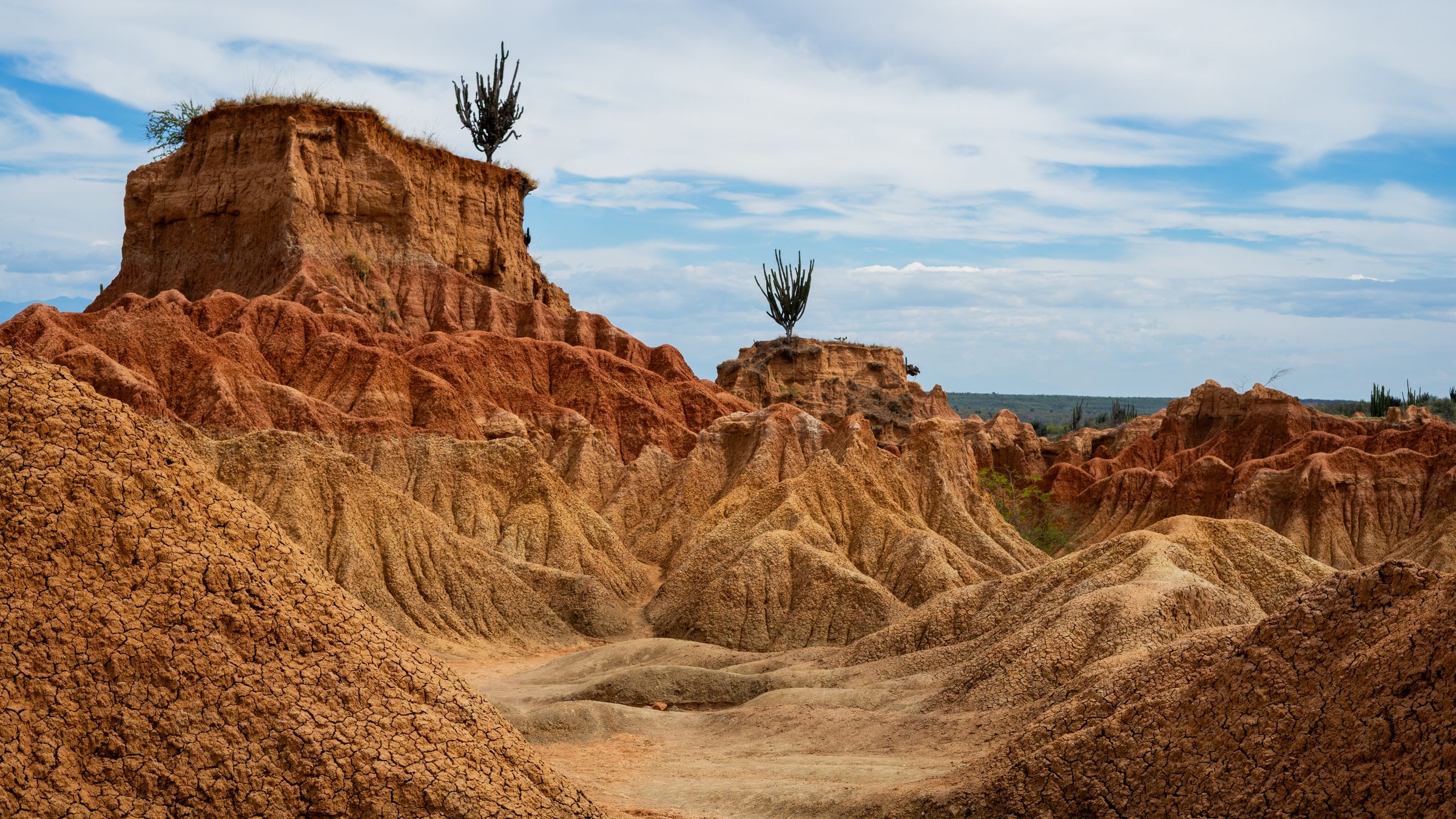
The Tatacoa Desert is a maze of red and grey clay canyons about 40 km (25 miles) from Neiva, in Huila department, under some of the darkest skies in Colombia: several observatories among the badlands open their telescopes to visitors every night. It isn’t a true desert but tropical dry forest, as the tree-sized cacti give away. I’d spend one night, ideally two: the afternoon for El Cuzco, the evening for the stars and sunrise for Los Hoyos. Below you’ll find how to get there from Neiva, how to get between the two areas, what it costs, where to stay and what UK and US travel advice says.
What Tatacoa is, and why it isn’t a real desert
Tatacoa is Colombia’s second-largest dry area after La Guajira: roughly 330-350 km² (130-135 sq miles) of eroded hills between the Magdalena river and the Eastern Andes, almost all in the municipality of Villavieja, at 400-450 m (1,300-1,500 ft). Technically it’s tropical dry forest: it gets around 1,000-1,100 mm (39-43 in) of rain a year, four times the cut-off for a true desert (250 mm, or 10 in). Heat and wind dry everything out fast, though, and the rain falls in a few short seasons, washing away the bare soil and carving the canyons.
The Spanish conquistador Gonzalo Jiménez de Quesada passed through in 1538 and called it the “valley of sorrows”; today’s name comes from tatacoa, the local word for the rattlesnakes. It’s also one of South America’s richest fossil beds: turtles, crocodiles, giant armadillos and monkeys lived here millions of years ago, when the area was a wet plain crossed by rivers. It’s protected as the La Tatacoa Integrated Management District (DRMI), run by CAM, the environmental authority for the upper Magdalena.
Things to do in the Tatacoa Desert
Tatacoa has two areas and you should see both: the red desert of El Cuzco, next to the observatories, and the grey desert of Los Hoyos, further along a dirt road. Colours, shapes and trails are different, and they fit neatly into one afternoon and one sunrise.
| Stop | Where | Time needed |
|---|---|---|
| El Cuzco labyrinths (red desert) | about 6 km (4 miles) from Villavieja, paved road | 1-2 hours |
| Mirador de Ventanas | on the road between El Cuzco and Los Hoyos | 20-30 minutes |
| Los Hoyos (grey desert) and pool | 5-8 km (3-5 miles) past the observatory, depending on the source | 2-3 hours |
| Observatories | next to El Cuzco | 1.5-2 hours in the evening |
| Paleontology Museum | in Villavieja town | 30-45 minutes |
The red desert: the El Cuzco labyrinths
El Cuzco is Tatacoa’s postcard view: a labyrinth of rust and ochre gullies, pinnacles and rain-fluted walls, crossed by marked trails in 1-2 hours. The paths cross each other and the gullies all look alike, though: without an offline map on your phone, hire a local guide, who charges 15,000-20,000 pesos per person for a 2-3 hour walk according to older sources. The best light is from 4pm until sunset, around 6pm, when the red glows; at midday the canyon floor turns into an oven.
Most sources say the El Cuzco trails are free to enter. Carry a few thousand pesos in cash anyway, in case someone asks for a contribution at the entrance.
The grey desert: Los Hoyos and its pool
Los Hoyos is further out and quieter: grey and bluish hills cut by deep ravines that look lunar at dawn. The main trail takes about an hour, and right next to it is the swimming pool of a private roadside restaurant, the only place to cool off in the desert, for about 10,000 pesos per person. Some sources also mention a small trail fee of around 3,000 pesos, but that figure isn’t recent.
Mirador de Ventanas
Halfway between the two areas, the Ventanas viewpoint looks down over the grey and red valleys with the mountains behind. It’s a short stop, usually part of tuk-tuk tours: ask your driver to pull over, especially at sunrise.
Villavieja and the Paleontology Museum
Villavieja is a hot, quiet town on the east bank of the Magdalena, with low houses and only a few streets. The Museo Paleontológico displays fossils found in Tatacoa, including bones, turtle shells and crocodile teeth: it’s small, but it’s the right place for the hottest hours. The entrance fee isn’t published online; town tours usually include it along with a boat ride on the Magdalena.
Stargazing in Tatacoa: observatories, prices and the best nights
The sky is the other reason to stay overnight: little light pollution, dry air and a latitude of about 3° north, so you can see constellations from both hemispheres, from the Southern Cross to the Big Dipper. Sessions start around 6:30-7pm and last 1.5-2 hours, usually combining a naked-eye tour of the sky with a laser pointer and views of planets and nebulae through telescopes.
- Observatorio Astronómico de la Tatacoa: the best known, right by El Cuzco; it also runs the town’s astronomy festival.
- Astrosur: the private observatory of astronomer Javier Fernando Rúa, who ran the main one for years, a short way off.
- Telescopes at your accommodation: several guesthouses and glamping sites in the desert have their own telescope and run sessions for guests.
Prices: sources give 10,000-18,000 pesos per person, depending on the length of the session and the number of telescopes; talks are almost always in Spanish. If it’s cloudy the session is cut short or cancelled, so ask in the afternoon whether it’s going ahead.
When to go for the stars: aim for the nights from a few days before to a few days after the new moon, because a full moon washes out the Milky Way. The clearest nights come in the dry months; between June and August the core of the Milky Way is also high in the early evening sky.
The Festival de Turismo Astronómico (also called the Star Party) brings astronomers and amateurs to Villavieja every year. Recent editions were held in August, but some sources mention July or November and the 2027 dates haven’t been announced yet: if you’re interested, follow the observatory’s and the town’s channels.
Is the Tatacoa Desert safe?
Yes, with normal precautions: neither UK nor US travel advice lists Huila among the areas to avoid.
- FCDO (UK, latest update 30 October 2026): no part of Huila is on its list of areas it advises against.
- US State Department (advisory of 31 March 2026): Level 3, “Reconsider travel”, the same as almost all of Colombia; the Level 4 areas don’t include Huila.
That doesn’t mean the department had a quiet 2026. In July Colombia’s ombudsman’s office (Defensoría del Pueblo) issued an early warning about FARC dissidents expanding into Aipe, Palermo, Santa María, Teruel and rural western Neiva; in October it reported drone attacks on police and soldiers in those municipalities, including one on Aipe’s police station on 5 October. On 31 October a motorcycle bomb in Algeciras, east of Neiva, killed a police officer. Aipe sits directly opposite Villavieja on the other bank of the Magdalena, but Villavieja and the desert aren’t named in the warning and no attacks on tourists have been reported. In practice: travel only by day, don’t carry on to Aipe and ask your accommodation about the situation before setting off. The rest of the rules are in our guide to safety in Colombia.
The more concrete risk is actually the heat. At midday there’s not a scrap of shade and you dehydrate fast: carry at least 2 litres (half a gallon) of water each per outing, plus a hat, sunscreen and closed shoes, because cactus spines go straight through sandals. Phone signal is patchy inside the desert, so tell your accommodation which route you’re taking.
How to get to the Tatacoa Desert
Fly from Bogotá to Neiva, Huila’s capital, then continue about 40 km (25 miles) by road to Villavieja, the town at the edge of the desert. From town to El Cuzco it’s another 6 km (4 miles), which you cover by tuk-tuk.
| Route | Time | Typical price |
|---|---|---|
| Flight Bogotá-Neiva | about 1 hour | depends on the date |
| Colectivo Neiva-Villavieja | 40-60 minutes | 10,000-20,000 pesos |
| Taxi or transfer Neiva-Villavieja | 40-45 minutes | agree beforehand |
| Tuk-tuk Villavieja-El Cuzco | 15 minutes | 10,000-25,000 pesos per ride |
| Bus San Agustín-Neiva | 4-5 hours | 40,000-70,000 pesos |
Neiva to Villavieja by colectivo
Neiva’s Benito Salas Airport (NVA) has several daily flights from Bogotá with Avianca, LATAM and Clic, taking about an hour; by bus from Bogotá it’s 5-6 hours. A short taxi ride from the airport takes you to the Terminal de Transportes, where colectivos for Villavieja leave: shared minibuses and cars that go when full, from morning to late afternoon. The fare was 10,000 pesos in late 2024; other sources quote 20,000 for direct minibuses, so check at the ticket window.
According to 2024 information the last colectivo leaves Neiva around 6pm and the last one leaves Villavieja around 5pm. Don’t rely on them: if you land in the afternoon, plan to reach town in daylight.
Taxi and transfers
A taxi from Neiva airport or bus terminal takes you straight to your accommodation, even inside the desert. There’s no fixed fare: agree the price before you get in, or ask your accommodation to arrange a transfer, which many do. It makes sense for groups of three or four, or if your flight lands late and you want to be in the desert before sunset.
From San Agustín
From San Agustín take a bus back to Neiva, 4-5 hours on Highway 45, where dissidents set fire to a truck between Gigante and Hobo in April 2026. Catch a morning bus so you reach Neiva in time for a colectivo; otherwise spend the night in Neiva and carry on the next day.
Getting around the desert: tuk-tuks, guides and bikes
The most practical option is a tuk-tuk (motocarro in Colombia) or a motorbike taxi, which you’ll find on Villavieja’s main square or your accommodation can call. There’s no public transport inside the desert.
- Tuk-tuk, single ride: 10,000-25,000 pesos from town to El Cuzco or the observatory, and about 25,000 from El Cuzco to Los Hoyos, according to sources from different years.
- Tuk-tuk, half day: to see both areas with stops and waiting time, expect from about 90,000 pesos per vehicle, though that figure isn’t recent. Agree on the stops, waiting time and number of passengers before you set off.
- Local guides: 15,000-40,000 pesos per person for one trail; a full day with transport costs 80,000-150,000 pesos per person. Tours from Neiva with transport and meals cost more but take care of everything.
- Bike: some guesthouses rent bikes. It only makes sense at dawn: the road to El Cuzco is paved but shadeless, and the track to Los Hoyos is dirt and sandy in places.
- On foot: from town to El Cuzco is 6 km (4 miles) in full sun, fine at 6am, not at noon. If you sleep near the observatory, the El Cuzco trails are a few minutes’ walk away.
Entrance fees and protected-area rules
There’s no single ticket for Tatacoa: you pay for each service, almost always in cash. Besides the pool and the observatory there’s a municipal fee, on which sources disagree: since 2022 Villavieja has charged agencies and operators 3,000 pesos for every visitor they bring into the desert, while some guides list an entrance fee of 10,000 pesos for adults and 8,000 for children. If you’re travelling independently, ask your accommodation whether and where you need to pay.
The La Tatacoa DRMI has few rules, but they matter:
- Stay on the trails and don’t climb the walls: the clay crumbles underfoot and the formations take centuries to re-form.
- Don’t take fossils or rocks: in Colombia fossils belong to the nation, and Tatacoa’s are still being studied.
- No litter and no fires: dry forest burns easily, and there’s no rubbish collection out in the desert.
Where to stay in the Tatacoa Desert
I’d spend at least one night inside the desert: the stars are outside your door and El Cuzco is a few minutes away at sunrise. Villavieja works if you want more comfort or a lower budget; Neiva only if you have no other choice.
| Area | Pros | Cons |
|---|---|---|
| In the desert, near the observatory | stars and sunrise on your doorstep, walk to El Cuzco | basic rooms, limited water and power in some places, few restaurants |
| Villavieja | colectivos, shops and restaurants close by, low prices | 6 km (4 miles) from El Cuzco, tuk-tuks needed for stars and sunrise |
| Glamping and remote lodges | quiet, pools, telescopes | high prices, transport needed for everything |
| Neiva | city hotels, handy for flights and buses | no stars or sunrise, an hour each way |
Typical prices per night: from about 30,000 pesos for a dorm bed or a hammock, 100,000-180,000 for a double room in a simple Villavieja hotel, and several hundred thousand pesos for glamping with a pool. Many guesthouses in the desert also allow camping: one older source quotes around 80,000 pesos for a pitched tent for two, and much less with your own tent. Many desert rooms only have a fan, so ask if you need air conditioning. Prices rise at Easter (Semana Santa), over Christmas and New Year and on Colombian holiday weekends, when domestic visitors pour in.
How many days you need: itineraries
One night is enough; two let you slow down and give you a second chance if the first night is cloudy. A day trip from Neiva is possible, but you’d miss the stars and the sunrise, the two best things here.
One night in Tatacoa
- Day 1 – Morning flight to Neiva and a colectivo to Villavieja. Lunch and the museum during the hottest hours. At 4pm take a tuk-tuk to El Cuzco and walk the labyrinths until sunset, then dinner and the observatory.
- Day 2 – Up at 5:30am for sunrise at Los Hoyos, the Ventanas viewpoint and a swim, if the pool is open. Back in Villavieja by 11am and a colectivo to Neiva.
Tatacoa and San Agustín in 6 days
- Day 1 – Fly Bogotá-Neiva, colectivo to Villavieja, El Cuzco at sunset and stargazing.
- Day 2 – Los Hoyos at sunrise, back to Neiva by early afternoon and a night there.
- Day 3 – Morning bus to San Agustín (4-5 hours).
- Days 4-5 – The archaeological park and the jeep tour to Alto de los Ídolos.
- Day 6 – Satena flight from Pitalito to Bogotá, or a bus to Neiva and a flight.
How to add Cali and Popayán without using the roads the advice warns against is explained in our guide to southwest Colombia.
Best time to visit Tatacoa, and the best time of day
It’s hot all year: 28-40 °C (82-104 °F) by day and around 20 °C (68 °F) at night. Rain comes in two seasons, roughly March-May and October-November; the driest months are June-August and December-February, but sources disagree on which is best: some say December-March, others June-August, when the sky is clearest. Showers here are short and the desert turns green after a downpour: the real nuisances are clouds at night and mud on the dirt tracks. How the weather changes across the rest of the country is covered in our guide to the best time to visit Colombia.
Close to the equator the sun rises around 6am and sets around 6pm all year. Walk between 5:30 and 9:30am and from 4pm to sunset; stay in the shade from 11am to 3pm. If you can, avoid Easter, the Christmas holidays and Colombian long weekends, when the El Cuzco trails get busy and the desert guesthouses fill up.
How much the Tatacoa Desert costs
| Item | Typical price |
|---|---|
| Colectivo Neiva-Villavieja | 10,000-20,000 pesos |
| Tuk-tuk from town to El Cuzco | 10,000-25,000 pesos per ride |
| Half-day tuk-tuk for both areas | from about 90,000 pesos per vehicle (older figure) |
| Local guide for one trail | 15,000-40,000 pesos per person |
| Full-day tour with transport | 80,000-150,000 pesos per person |
| Los Hoyos pool | about 10,000 pesos |
| Observatory | 10,000-18,000 pesos |
| Dorm bed or hammock | from about 30,000 pesos |
| Double room in Villavieja | 100,000-180,000 pesos |
| Restaurant meal | 18,000-35,000 pesos |
Take out cash in Neiva: tuk-tuks, guides, the pool and the observatory almost always want cash.
Mistakes to avoid
- Hiking between 11am and 3pm, when the canyon floor easily passes 40 °C (104 °F).
- Heading out without water: at least 2 litres (half a gallon) each, plus a hat and sunscreen.
- Visiting on a day trip and missing the stars and sunrise.
- Booking the observatory at full moon and expecting the Milky Way.
- Climbing the walls or leaving the trails, for your safety and to limit erosion.
- Lingering under the Los Hoyos cliffs after days of rain.
- Settling the tuk-tuk price at the end: agree it before you leave.
- Catching the last colectivo or driving Huila’s roads after dark.
- Pocketing a fossil as a souvenir.
- Travelling without a yellow fever vaccination.
FAQs
Is the Tatacoa Desert a real desert?
No, technically it’s tropical dry forest, because it gets around 1,000-1,100 mm (39-43 in) of rain a year, far more than a desert. It looks like one because of the heat, the bare ground and the cacti, and because rain falling in a few short seasons erodes the clay.
How much does it cost to visit the Tatacoa Desert?
There’s no single ticket: the Los Hoyos pool costs about 10,000 pesos, the observatory 10,000-18,000 and a tuk-tuk from town to El Cuzco 10,000-25,000 per ride. Sources disagree on a municipal fee of 3,000-10,000 pesos per person, so ask your accommodation whether you need to pay it.
How do you get to the Tatacoa Desert from Bogotá?
Fly from Bogotá to Neiva, about an hour, then take a 40-60 minute colectivo from Neiva’s bus terminal to Villavieja and a tuk-tuk into the desert. By bus, Bogotá to Neiva takes 5-6 hours.
Can you do Tatacoa as a day trip from Neiva?
Yes, but it’s a shame: you’d see the canyons in the hottest hours and miss the stars and the sunrise. With one night in the desert you see both areas in the right light.
Is the Tatacoa Desert safe to visit?
Yes, with normal precautions: neither the FCDO nor the US State Department advises against Huila. Armed groups did carry out attacks in Aipe and other nearby municipalities in 2026, so travel by day, and inside the desert worry mostly about the heat.
Some links are affiliate links: if you buy through them I earn a small commission, at no extra cost to you. How it works
Nearby and worth combining
Southwest
San Agustín
San Agustín, Colombia's land of pre-Columbian stone statues: 2026 archaeological park entrance fee, getting there via Neiva or Pitalito, jeep tours and safety.