Dishes · Antioquia
Bandeja paisa
What bandeja paisa is, Medellín's signature dish: every ingredient explained, how much it costs, where to eat it and how to order it without overdoing it.
In this guide
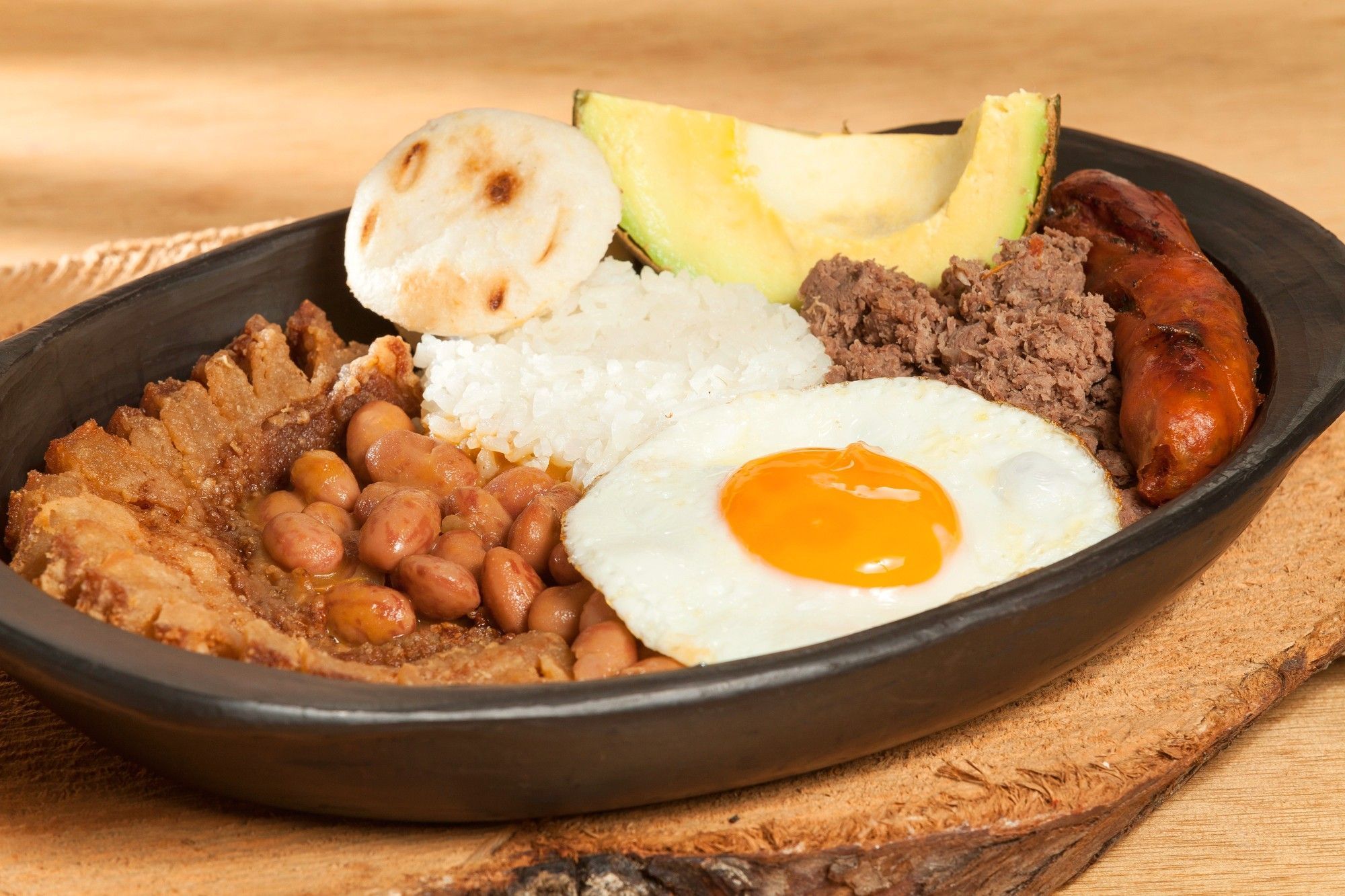
Bandeja paisa is the signature dish of Antioquia and the Coffee Region: a huge platter of red beans, rice, ground beef, chicharrón, chorizo, a fried egg, plantain, arepa and avocado. It’s enormous, it’s eaten at lunchtime and in Medellín it costs around 40,000 pesos on average. It isn’t light and Colombians don’t eat it every day, but trying it at least once, slowly and on an empty stomach, is part of the trip. Here’s what’s on the plate, what it costs, where to eat it and how to order it.
What bandeja paisa is and where it comes from
“Paisa” is the name for the people of Antioquia and the Coffee Region. The bandeja grew out of peasant cooking and the food of the arrieros, the mule drivers who carried goods across the mountains and needed a single, filling meal for long, hard days. Beans, rice, corn and pork were staples in every home.
The name is more recent: the bandeja, the large oval platter, became common in popular restaurants in the mid-20th century, when the various components started being served together as a single portion. Today it’s the region’s most representative dish and one of the best known in Colombian food.
What’s in a bandeja paisa
| Component | What it is |
|---|---|
| Frijoles | red beans, often the cargamanto variety, slow-cooked with a little pork |
| Arroz | plain white rice |
| Carne molida or carne en polvo | ground or very finely minced beef, almost a powder |
| Chicharrón | fried pork belly, crunchy outside and soft inside |
| Chorizo | Antioquian pork sausage, grilled |
| Huevo frito | a fried egg, on top of the rice |
| Tajada | a slice of fried ripe plantain, sweet |
| Arepa | a small, unsalted white corn cake |
| Aguacate | a few slices of avocado |
Depending on the restaurant you may also get morcilla (black pudding with rice), hogao (a tomato and spring onion sauce) to pour over the beans, or a bowl of broth. Bandeja montañera is an even bigger version with extra meats. The chicharrón is the most loved and the heaviest part: if you don’t like fat, you can ask them to leave it out.
How much does bandeja paisa cost?
Prices depend a lot on the neighbourhood and the restaurant. These are rough prices in Medellín:
| Where | Rough price |
|---|---|
| City average | about 40,000 pesos |
| Best-known traditional restaurants | 54,000 to 64,000 pesos and up |
| Pueblito Paisa (Cerro Nutibara) | about 35,000-40,000 pesos |
In touristy neighbourhoods such as El Poblado prices are higher; in Laureles, Envigado and the centre you’ll get the same bandeja for less. Your bill may include the optional 10% propina voluntaria, as explained in our guide to money in Colombia.
Where to eat bandeja paisa
In Medellín you’ll find it everywhere: in traditional paisa restaurants, in neighbourhood eateries serving the corrientazo (set lunch) and in markets. In my view the best place is a paisa restaurant in Laureles or the centre at lunchtime, full of Colombians on their work break. Pueblito Paisa, a replica Antioquian village on top of Cerro Nutibara, is touristy but handy if you combine it with the city views.
Outside the city it’s a staple in Antioquia towns such as Guatapé, Jardín and Santa Fe de Antioquia, and at the fondas, the roadside restaurants on mountain roads, such as those on the way to Rionegro airport. You’ll also often find it in the Coffee Region, for example in Salento, although the local dish to try there is trout.
There are paisa restaurants in Bogotá and across the country too, but for the most authentic version it’s worth waiting until you reach Antioquia.
My favourite restaurants in Medellín
The best bandeja paisa I’ve eaten in Colombia was in Medellín, at three restaurants in the El Poblado neighbourhood:
- Hacienda: it has several branches; the most characterful, with a traditional setting, is inside the La Strada shopping centre on Avenida El Poblado (Carrera 43A #1 Sur-150, unit 225).
- Restaurante La Matriarca: Calle 8 #43B-62, a short walk from Parque del Poblado.
- Mondongo’s: Calle 10 #38-38, near Parque Lleras.
How to order it
- When: at lunch. Many Colombians find it too heavy in the evening and some restaurants only serve it at midday.
- How much: if you’re not very hungry, ask for a media bandeja; it’s often more than enough.
- To drink: a fresh limonada, an aguapanela (water with unrefined cane sugar) or, after the meal, a mazamorra, a corn drink with milk and panela.
- Useful phrases: “¿Me regala una bandeja paisa, por favor?” (could I have a bandeja paisa, please?), “Una media bandeja” (a half portion) and “Sin chicharrón” if you’d rather skip it.
- If you’re vegetarian: some restaurants make a bandeja vegetariana with beans, rice, egg, plantain, arepa and avocado; always ask whether the beans are cooked with pork.
Frequently asked questions
What is in a bandeja paisa?
Red beans, rice, ground beef, chicharrón, chorizo, a fried egg, fried ripe plantain, arepa and avocado, all served together on one large platter. Some restaurants add morcilla and hogao.
How much does a bandeja paisa cost in Medellín?
About 40,000 pesos on average; at the best-known traditional restaurants you’ll pay 54,000 to 64,000 pesos. In less touristy neighbourhoods such as Laureles and Envigado it costs less.
Where can I eat the most authentic bandeja paisa?
In Medellín and the towns of Antioquia, at traditional paisa restaurants and at the fondas along mountain roads.
Is bandeja paisa eaten for lunch or dinner?
For lunch: it’s a very big dish and some restaurants only serve it at midday. If you’re not very hungry, ask for a media bandeja.
Is there a vegetarian bandeja paisa?
Yes, some restaurants make it without meat, with beans, rice, egg, plantain, arepa and avocado. Ask whether the beans are cooked with pork, as in the traditional recipe.
More Colombian flavours
Coffee Region
Colombian coffee: tinto, Juan Valdez, coffee farms and what to buy
Colombian coffee for travellers: how to order it (tinto, perico, aromática), who Juan Valdez is, how to visit a coffee farm and which coffee to take home.