Place · Caribbean coast
San Basilio de Palenque
San Basilio de Palenque, the first free town in the Americas, with its own language and drums: day trip from Cartagena by tour or bus, costs and etiquette.
In this guide
- Why visit Palenque: a short history
- Things to do in San Basilio de Palenque
- How to get to Palenque from Cartagena
- Is Palenque safe? Travel advisories
- Etiquette: photos, tips and guides
- The Palenque Drum Festival
- Where to stay: Cartagena is the better base
- How long you need and a sample day
- Best time to visit Palenque
- Practical tips
- How much does Palenque cost?
- Mistakes to avoid
- FAQ
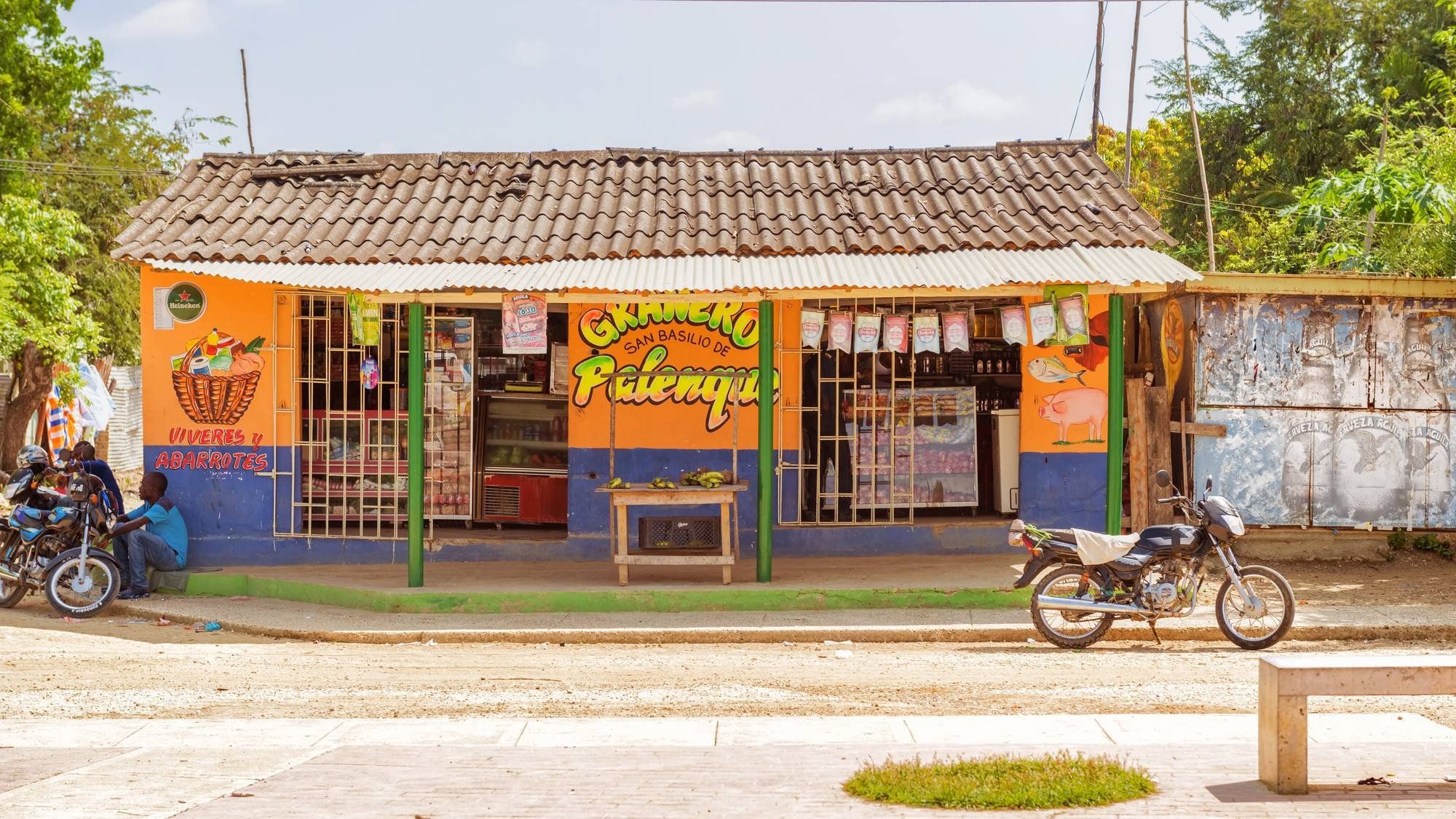
San Basilio de Palenque (usually just Palenque) is a town of a few thousand people in the municipality of Mahates, Bolívar department, about an hour from Cartagena. It was founded by enslaved Africans who escaped from the city and the plantations, and it still speaks its own language, Palenquero, and keeps music, rituals and social structures that came from Africa: that’s why its cultural space has been on UNESCO’s intangible heritage list since 2005. Don’t expect a postcard village: it’s dirt roads, low houses and motorbike taxis. You come for the people, the history and the drums, and I think it’s worth one day of your Cartagena stay, ideally with a guide from the town. Below: how to get there by tour or on your own, what to see, costs and etiquette. Not to be confused with the Maya ruins of Palenque in Mexico.
Why visit Palenque: a short history
Palenque calls itself the first free town in the Americas. Around the turn of the 17th century Benkos Biohó, an enslaved man brought to Cartagena from West Africa, escaped and led a community of cimarrones (runaways) in the swamps and hills south of the city. The Spanish signed a truce with him, then captured him and hanged him in Cartagena in 1621. The palenques, the runaways’ fortified villages, kept resisting, and between the late 1600s and 1713 the Spanish Crown recognised San Basilio’s freedom (sources give different dates for the agreement).
The “first” title is debated: other runaway communities, such as Yanga in Mexico, also won their freedom in the same century. What’s certain is that San Basilio is the only one of Colombia’s palenques to survive to this day, and that explains the rest:
- The Palenquero language: according to the safeguarding plan written by the community with Colombia’s Ministry of Culture, it’s the only Spanish-based creole in the Americas, with many words of Bantu origin. It’s now taught at school and you’ll see it painted on murals.
- Kuagros: groups of people of the same age, formed in childhood, who stay together for life and help each other with work, celebrations and mourning.
- Lumbalú: the funeral rite, with nine days of songs and drums. It’s a private community moment, not a show.
- Traditional medicine: healers and knowledge of plants, which many tours show in a medicinal garden.
Palenque is officially a corregimiento (a village within Mahates). A 2024 law allows it to become a municipality in its own right, but the referendum planned for November 2025 was suspended and in August 2026 the Bolívar regional government opened a new consultation with the community.
Things to do in San Basilio de Palenque
You can walk around the town in 2-3 hours. Without a guide you’ll see the streets and the square but miss almost everything else: houses, musicians and stories open up when you arrive with someone local.
| What | Time | Price |
|---|---|---|
| Main square and Benkos Biohó statue | 20 minutes | free |
| Guided walk around town | 2-3 hours | from about 69,000 pesos (guide only) |
| Music and dance (music houses, schools) | 1 hour | included in tours or a donation |
| Traditional lunch | 1 hour | included in many tours |
The main square and the Benkos Biohó statue
Every visit starts in the main square, where the bronze statue of Benkos Biohó shows a man breaking his chains with his arm outstretched. Around it are the church of San Basilio, shady benches, women selling sweets and murals with phrases in Palenquero. Local guides usually wait here, and this is where motorbike taxis from the main road drop you.
Music: drums, son palenquero and champeta
Music is why many people make the trip. Palenque gave birth to son palenquero (made famous by Sexteto Tabalá), bullerengue sentado and the lumbalú songs that Las Alegres Ambulancias took beyond the town; Palenqueros who moved to Cartagena were key to the birth of champeta, the music you’ll hear blasting in every working-class neighbourhood on the coast. Today there’s also rap in Palenquero by Kombilesa Mí, who run a small music house-museum. The Batata dance and music school teaches kids traditional drumming and dances: many tours include a short performance or a drumming lesson.
Kid Pambelé and boxing
Palenque gave Colombia its first world champion: Antonio Cervantes, “Kid Pambelé”, light welterweight world champion from 1972. There’s a monument to the boxer in town and guides tell his story and that of other Palenquero fighters. I couldn’t find a boxing museum with opening hours and a ticket: treat the monument as a quick stop.
Traditional medicine, the stream and daily life
Guides usually take you to a medicinal plant garden, where a healer explains what the leaves and roots are for, and to the Casa de la Cultura, where community meetings and activities take place. Many tours also pass by the arroyo, the stream where for centuries women fetched water and washed clothes and where people bathe; parts of it are now polluted. It’s a place of everyday life, not an attraction: don’t photograph people bathing or doing laundry.
Sweets and the palenqueras
The palenqueras you see in Cartagena with a bowl of fruit on their head and yellow, blue and red dresses mostly come from here: for generations Palenque’s women have travelled to the city to sell fruit and sweets. In town they’re still made at home: coconut cocadas, alegrías (coconut, panela and millo, a toasted grain) and cassava enyucado. Buy them straight from the people who make them: they’re cheap and you’ll often get a demonstration.
How to get to Palenque from Cartagena
Palenque is about 50-60 km (30-37 miles) from Cartagena: you leave the city on the Troncal de Occidente highway and, shortly before Malagana, turn onto a side road for a few kilometres to the town. By car it takes 1-1.5 hours, depending on traffic leaving Cartagena and around Turbaco.
| How | Time each way | Approximate price |
|---|---|---|
| Day tour | 1-1.5 hours | 230,000-350,000 pesos per person |
| Bus + motorbike taxi | 1.5-2.5 hours | 25,000-35,000 pesos |
| Taxi return trip | 1-1.5 hours | about 450,000 pesos (one source) |
On a tour (the easy option)
It’s the most comfortable way and, I think, the most sensible on a first visit. Tours pick you up at your hotel or at the Clock Tower between 8 and 9am, reach Palenque around 10am and are back in Cartagena between 2:30 and 4pm. They usually include air-conditioned transport, a guide, a traditional lunch and some music or dance.
- Prices: Colombian agencies that publish prices in pesos charge 230,000-350,000 pesos per person with transport, guide and lunch (2025-2026 listings). Tours on international sites such as Civitatis, GetYourGuide and Viator are sold in US dollars or euros.
- Just the town walk: if you get there yourself, some agencies sell a guided walk in Palenque from about 69,000 pesos (110,000 with lunch); Civitatis has a guided visit of about 3 hours meeting in the square, sold in another currency. There’s also a tip-based free walking tour of about 2.5 hours.
- Your guide matters: pick a tour with a guide born in Palenque and ask the agency for its RNT number (Registro Nacional de Turismo), which every tourism business in Colombia must have.
On your own: bus to the turn-off and motorbike taxi
- Go to Cartagena’s Terminal de Transportes, on the edge of the city (20-40 minutes by taxi from the old town).
- Take a bus or minibus heading for Mahates, San Juan Nepomuceno or El Carmen de Bolívar and ask the driver to drop you at the Palenque turn-off (“el cruce de Palenque”), just before Malagana.
- Motorbike taxis (mototaxis) wait at the junction and get you to the square in a few minutes.
According to 2025-2026 sources, bus plus motorbike taxi costs 25,000-35,000 pesos each way and takes 1.5-2.5 hours with waiting time; older guides gave much lower prices, so always ask before you get on. To return, get a ride back to the turn-off and flag down a Cartagena-bound bus: a 2022 guide gave the last one at around 5:30pm on weekdays, but that’s not an official timetable. I’d head back by 3-4pm.
Taxi or private transfer
A taxi from Cartagena that waits for you isn’t cheap: one article quotes about 450,000 pesos return, to be agreed in advance. Private transfers sold online are priced in US dollars. They make sense for three or four people, or if you want to stop in Palenque on the way to Mompox (see below).
Is Palenque safe? Travel advisories
The town is calm and used to visitors; as in the whole area, the risk is on rural roads and at night.
- The UK FCDO (updated 30 October 2026) advises against all but essential travel to the southern part of Bolívar department: Palenque is in the north, an hour from Cartagena, and outside that area.
- The US State Department keeps Colombia at Level 3 (Reconsider travel) since 31 March 2026; Bolívar isn’t among the Level 4 areas.
- Some other governments’ advisories, such as Spain’s, list the Montes de María hills between Bolívar and Sucre as high-risk. Palenque sits in a valley at the foot of these hills, but the municipality of Mahates belongs to the Canal del Dique subregion, not to the Montes de María (whose Bolívar municipalities are Córdoba, El Carmen de Bolívar, El Guamo, María La Baja, San Jacinto, San Juan Nepomuceno and Zambrano). In practice, the town and the road from Cartagena are outside that area, which starts a few kilometres away, towards María La Baja and San Jacinto.
- In 2026 Colombia’s ombudsman (Defensoría del Pueblo) issued early warnings for southern Bolívar and for Magangué, where the Clan del Golfo operates; I found no recent warnings for Mahates or Palenque.
In practice: visit in daylight, be back in Cartagena before dark, don’t drive the Troncal de Occidente at night and don’t head into the rural Montes de María without checking first. The big picture is in the guide to safety in Colombia.
Etiquette: photos, tips and guides
Palenque is a place where people live, not an open-air museum. A few simple rules:
- Photos: always ask before photographing someone, especially older people, children and anyone working. If someone poses for you, it’s normal to give a few thousand pesos.
- Entrance: I found no entrance ticket or compulsory community fee to enter the town. You pay for the guide, performances and anything you buy.
- Tips: many tours don’t include tips for guides and musicians. Carry small notes for the guide, the musicians and the families who open their doors.
- Guides: young men will offer you a tour in the square. They can be excellent, but agree on length and price first and ask if they’re from Palenque.
- Lumbalú: if there’s a funeral, keep your distance and don’t take photos.
The Palenque Drum Festival
The Festival de Tambores y Expresiones Culturales is the town’s biggest event: three or four days of concerts, dance groups, workshops on drumming, traditional hair braiding and the Palenquero language, and talks on local history. In 2026 it ran from 9 to 12 October (the 41st edition).
It usually falls on the October public holiday weekend: in 2027 that Monday holiday is 18 October, so the most likely dates are around 15-18 October, but that’s my guess until the organisers announce them. Tours from Cartagena fill up and there’s nowhere to stay in town: if you want the evening concerts, book a private transfer back before you go.
Where to stay: Cartagena is the better base
I’d stay in Cartagena and visit Palenque as a day trip. I found no guesthouses or homestays in town with published prices; booking sites list a hotel named after the town, but it’s in the wider Mahates area about 5 km from the square, with prices in US dollars. If you’d like to stay with a local family, ask your guide: some families host visitors, but it needs arranging in advance.
In Cartagena, Getsemaní or the old town are the handiest areas for early tour pickups; the neighbourhoods are compared in the Cartagena guide.
How long you need and a sample day
Palenque needs half a day on a tour or a full day on your own. More than one day only makes sense for the Drum Festival.
A day trip from Cartagena on your own
- 7:30am: taxi to the bus terminal and bus towards Mahates.
- 9:30am: motorbike taxi from the turn-off to the square, meet a local guide.
- 10am-1pm: Benkos Biohó statue, music houses, medicinal plants, Kid Pambelé monument, sweets.
- 1pm: fried fish or chicken with coconut rice at a family home or small restaurant.
- 2:30-3pm: motorbike taxi to the turn-off and bus back, arriving before sunset.
Fitting it into your trip: with a week on the coast, I’d spend 3-4 days in Cartagena, with one day at the Rosario Islands and one in Palenque, then 2 nights in Mompox or head on to Santa Marta. The road to Mompox follows the Troncal de Occidente for a stretch and passes near the Palenque turn-off: with a private transfer you can ask for a 2-3 hour stop, but it turns into a 9-10 hour day and you need to reach Mompox before dark. It doesn’t work with the Unitransco bus: do Palenque as a day trip from Cartagena. Other stops are on the Caribbean coast page.
Best time to visit Palenque
Palenque is hot all year, often above 33°C (91°F) in the middle of the day, with more humidity and less breeze than Cartagena.
- December-April: the dry season and the easiest time: dry roads and clear skies.
- May-November: the rainy season, with afternoon storms; October and November are the wettest months and the dirt roads turn to mud. October is also Drum Festival month, though.
Arrive in the morning and do your outdoor sightseeing before noon. How the rest of the country compares is in the guide on the best time to visit Colombia.
Practical tips
- Cash: I found no reliable information on ATMs in town, and guides, musicians, motorbike taxis and sweet sellers want cash. Withdraw in Cartagena and bring small notes.
- Health: in 2026 Bolívar is one of the departments with the most dengue cases (6,580 by 1 September): wear repellent. For yellow fever, Mahates and Cartagena are low risk in the Colombian Ministry of Health table updated on 31 March 2026.
- Heat: hat, sunscreen and water; tours often include water, but an extra bottle helps.
- Phone: I found no reliable data on mobile coverage in town; download an offline map and save your guide’s or agency’s number.
- Clothing: light clothes and closed shoes, as the streets are unpaved.
How much does Palenque cost?
| Item | Approximate price |
|---|---|
| Day tour from Cartagena (Colombian agencies) | 230,000-350,000 pesos per person |
| Tours on international sites | sold in US dollars or euros |
| Bus + motorbike taxi from Cartagena | 25,000-35,000 pesos each way |
| Return taxi with waiting time | about 450,000 pesos |
| Guide in town | from about 69,000 pesos, 110,000 with lunch |
| Entrance to the town | no ticket |
| Traditional sweets | a few thousand pesos |
Mistakes to avoid
- Going without a guide and only seeing the square: you’ll see little and understand less.
- Photographing people without asking, especially children and anyone working or bathing at the stream.
- Heading back after dark or driving the Troncal de Occidente at night.
- Setting off without checking for blockades on the road: there were several in 2026.
- Relying on ATMs or cards.
- Expecting to watch a lumbalú: it’s a funeral rite.
- Mixing up Palenque with the Maya ruins of Palenque in Mexico when you search for tours and photos online.
FAQ
Is San Basilio de Palenque worth visiting?
Yes, if you’re interested in the history of Africans in Colombia, music and people more than monuments. With a good local guide it’s one of the most rewarding day trips from Cartagena; if you want beaches or colonial architecture, choose the islands or Mompox.
How far is Palenque from Cartagena?
About 50-60 km (30-37 miles), or 1-1.5 hours by car or minivan. By bus plus motorbike taxi from the Malagana turn-off it takes 1.5-2.5 hours including waits.
Can you visit Palenque without a tour?
Yes: bus from the Terminal de Transportes towards Mahates, get off at the turn-off before Malagana and take a motorbike taxi to the square, for 25,000-35,000 pesos each way according to recent sources. It’s still worth hiring a local guide in town and leaving by mid-afternoon.
Is there an entrance fee for Palenque?
No, I found no entrance ticket or compulsory contribution. You pay for the guide, performances and what you buy, and tips are appreciated.
When is the Palenque Drum Festival?
In mid-October, usually over the public holiday weekend: in 2026 it ran from 9 to 12 October. The 2027 dates haven’t been announced yet.
Some links are affiliate links: if you buy through them I earn a small commission, at no extra cost to you. How it works
Nearby and worth combining
Caribbean coast
Mompox
Mompox, the UNESCO-listed filigree town on the Magdalena River: how to get there from Cartagena, things to do, Holy Week 2027 and where to stay.
Caribbean coast
Cartagena de Indias
Cartagena, Colombia travel guide: the country's most beautiful colonial city, how many days you need, the best area to stay, airport transfers and costs.